Go Law
The California Durable Power of Attorney form is a crucial legal document that allows individuals to designate someone they trust to make decisions on their behalf, particularly in financial and healthcare matters, when they are unable to do so themselves. This form remains effective even if the individual becomes incapacitated, ensuring that their wishes are respected and upheld. It grants the appointed agent a wide range of powers, which can include managing bank accounts, paying bills, and making medical decisions. Importantly, individuals can customize the powers granted to their agent, tailoring the document to fit their unique needs and preferences. Understanding the implications of this form is essential, as it not only provides peace of mind but also safeguards against potential disputes or confusion among family members during challenging times. Proper execution of the Durable Power of Attorney is vital; it must be signed, dated, and notarized to ensure its validity. By taking the time to create this document, individuals can secure their future and ensure that their affairs are handled according to their wishes.
California Durable Power of Attorney
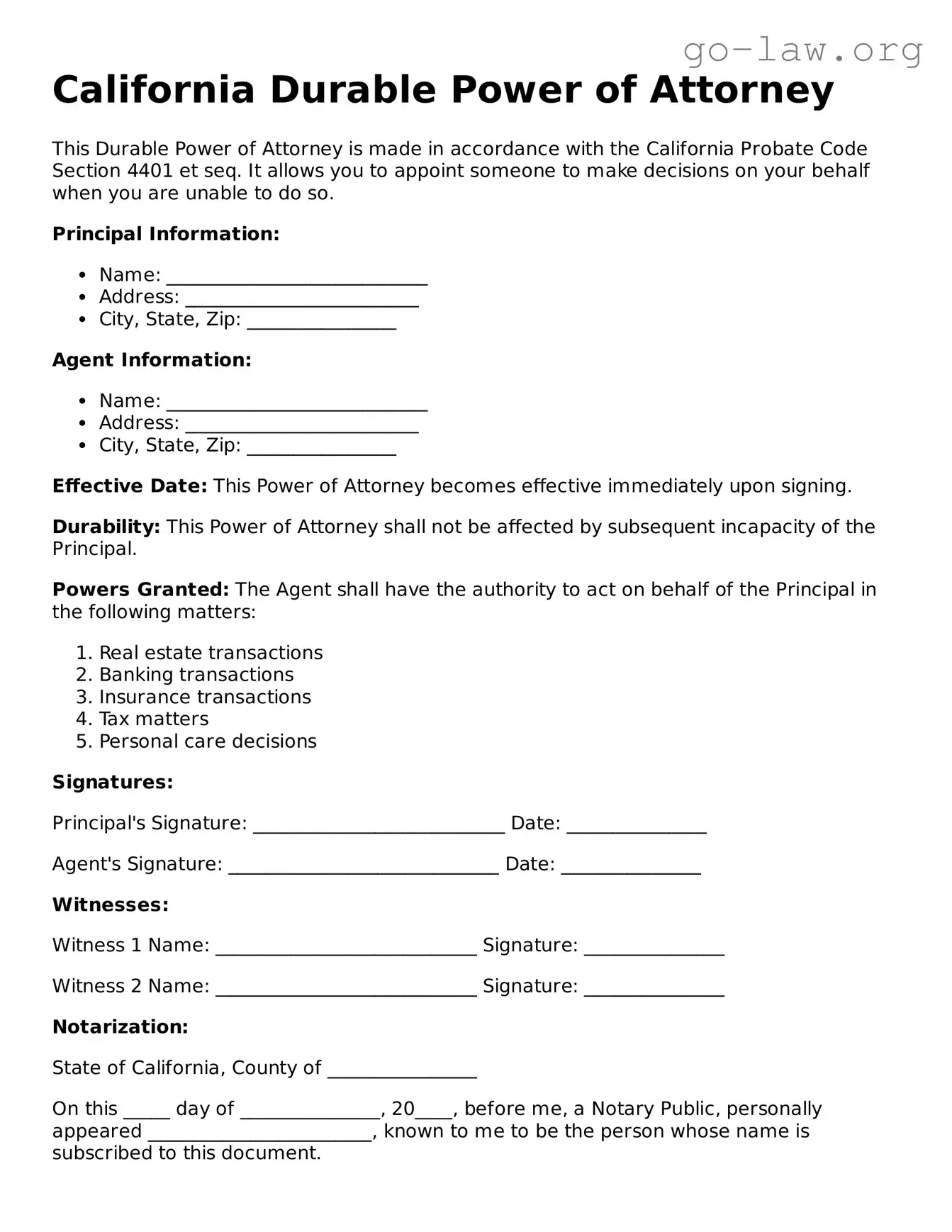
This Durable Power of Attorney is made in accordance with the California Probate Code Section 4401 et seq. It allows you to appoint someone to make decisions on your behalf when you are unable to do so.
Principal Information:
Agent Information:
Effective Date: This Power of Attorney becomes effective immediately upon signing.
Durability: This Power of Attorney shall not be affected by subsequent incapacity of the Principal.
Powers Granted: The Agent shall have the authority to act on behalf of the Principal in the following matters:
Signatures:
Principal's Signature: ___________________________ Date: _______________
Agent's Signature: _____________________________ Date: _______________
Witnesses:
Witness 1 Name: ____________________________ Signature: _______________
Witness 2 Name: ____________________________ Signature: _______________
Notarization:
State of California, County of ________________
On this _____ day of _______________, 20____, before me, a Notary Public, personally appeared ________________________, known to me to be the person whose name is subscribed to this document.
Notary Public Signature: ___________________________
My Commission Expires: _______________
| Fact Name | Description |
|---|---|
| Definition | A Durable Power of Attorney allows an individual to designate someone to make financial or legal decisions on their behalf, even if they become incapacitated. |
| Governing Law | The California Durable Power of Attorney is governed by the California Probate Code, specifically Sections 4000-4545. |
| Durability | This type of power of attorney remains effective even if the principal becomes incapacitated, distinguishing it from a standard power of attorney. |
| Principal and Agent | The person granting authority is called the principal, while the person receiving authority is known as the agent or attorney-in-fact. |
| Execution Requirements | The form must be signed by the principal and notarized or witnessed by two individuals who are not named in the document. |
| Revocation | The principal can revoke the Durable Power of Attorney at any time, as long as they are mentally competent. |
| Limitations | While broad powers can be granted, the principal can specify limitations on the authority given to the agent. |
| Agent's Responsibilities | The agent is required to act in the best interests of the principal and must keep accurate records of all transactions made on their behalf. |
| Common Uses | This form is often used for managing finances, real estate transactions, and healthcare decisions when the principal is unable to do so. |
Filling out the California Durable Power of Attorney form is a straightforward process. Once completed, this form allows you to designate someone to make decisions on your behalf in case you become unable to do so. Follow these steps carefully to ensure accuracy.
A California Durable Power of Attorney is a legal document that allows an individual (the principal) to appoint someone else (the agent) to make decisions on their behalf regarding financial and legal matters. This document remains effective even if the principal becomes incapacitated, ensuring that their affairs can be managed without interruption.
Creating a Durable Power of Attorney is important for several reasons:
In California, you can choose anyone to be your agent, as long as they are at least 18 years old and mentally competent. Many people select trusted family members, close friends, or professionals such as attorneys or financial advisors.
You have the flexibility to grant a variety of powers to your agent, including but not limited to:
It is essential to clearly outline the specific powers you wish to grant to avoid any confusion in the future.
Yes, in California, a Durable Power of Attorney must be signed by the principal and notarized to be legally valid. Alternatively, the document can be signed by two witnesses who meet certain criteria. It is advisable to consult with a legal professional to ensure compliance with all requirements.
Absolutely. You can revoke a Durable Power of Attorney at any time as long as you are mentally competent. To do so, you should create a written revocation document and notify your agent and any relevant institutions or individuals that may have a copy of the original document.
If you do not have a Durable Power of Attorney and become incapacitated, your family may need to go through the court process to establish a conservatorship. This can be time-consuming, costly, and may not align with your wishes. Having a Durable Power of Attorney in place can help avoid these complications.
To create a Durable Power of Attorney in California, follow these steps:
Consulting with a legal professional can ensure that your document meets all legal requirements and accurately reflects your intentions.
Filling out a California Durable Power of Attorney (DPOA) form can seem straightforward, but many people make common mistakes that can undermine its effectiveness. One frequent error is failing to specify the powers granted to the agent clearly. The form allows individuals to designate broad or specific powers, but if these are not clearly outlined, the agent may not have the authority to act as intended. This lack of clarity can lead to confusion and potential disputes later on.
Another mistake often made is neglecting to date the document. A DPOA is only valid if it is properly executed, which includes dating the form at the time of signing. Without a date, it may be challenging to determine when the authority was granted, which can create complications if the principal's mental capacity is questioned later. It’s essential to ensure that all parties involved understand when the powers begin and under what conditions they remain valid.
Additionally, individuals sometimes forget to have the DPOA signed by a witness or notarized, depending on the specific requirements. While California does not require witnesses for a DPOA to be valid, having a notary public can add an extra layer of legitimacy and help prevent future challenges. Skipping this step can lead to disputes about the authenticity of the document, especially if it is called into question during a critical time.
Lastly, many people fail to communicate their intentions with the appointed agent. A DPOA is not just a legal document; it represents a trust in another person to make decisions on one's behalf. Without discussing the scope of authority and specific wishes, the agent may act in ways that do not align with the principal's desires. Open communication can help ensure that the agent understands their role and the values that should guide their decisions.
A California Durable Power of Attorney (DPOA) is a crucial legal document that allows an individual, known as the principal, to designate another person, referred to as the agent, to make financial and legal decisions on their behalf. While the DPOA is vital for managing affairs, several other forms and documents can complement it, ensuring a comprehensive approach to planning for future needs. Below is a list of additional documents often used alongside the California Durable Power of Attorney.
Each of these documents plays a significant role in a comprehensive estate plan. Together, they help individuals ensure that their wishes are respected and that their affairs are managed according to their preferences, both during their lifetime and after their passing.
The California Durable Power of Attorney (DPOA) form is similar to a General Power of Attorney (GPOA). Both documents allow an individual, known as the principal, to designate another person, called an agent, to make decisions on their behalf. The key difference lies in the durability aspect; while a GPOA may become invalid if the principal becomes incapacitated, a DPOA remains effective even when the principal is unable to make decisions. This makes the DPOA particularly useful for long-term planning and ensuring that someone can manage affairs during periods of incapacity.
A Medical Power of Attorney (MPOA) shares similarities with the DPOA in that it allows an individual to appoint an agent to make healthcare decisions on their behalf. Like the DPOA, the MPOA can remain effective even if the principal becomes incapacitated. However, the focus of the MPOA is specifically on medical and health-related decisions, such as treatment options and end-of-life care, making it a critical document for those who wish to ensure their healthcare preferences are honored.
The Living Will, or Advance Healthcare Directive, is another document that complements the DPOA. While the DPOA appoints someone to make decisions, a Living Will outlines specific wishes regarding medical treatment and interventions in the event of terminal illness or irreversible condition. This document can guide the agent appointed in a DPOA, providing clarity on the principal's desires when they cannot communicate them themselves.
A Revocable Trust shares a connection with the DPOA in that both can help manage an individual's assets. A Revocable Trust allows a person to place their assets into a trust, which can be managed by a trustee during their lifetime and distributed upon their death. Unlike the DPOA, which focuses on decision-making authority, a Revocable Trust provides a structured way to handle financial assets, offering privacy and avoiding probate, which can be beneficial for estate planning.
The Springing Power of Attorney is another variant related to the DPOA. It becomes effective only upon the occurrence of a specific event, usually the principal's incapacity. This type of power of attorney can be appealing for those who want to maintain control over their affairs until they truly need assistance. Like the DPOA, it allows for the delegation of authority but with a conditional trigger for activation.
A Financial Power of Attorney (FPOA) is closely aligned with the DPOA, as both documents empower an agent to handle financial matters. The FPOA specifically focuses on financial transactions, such as managing bank accounts, paying bills, and handling investments. While a DPOA can encompass broader decision-making authority, the FPOA is tailored for financial responsibilities, making it an essential tool for managing one’s economic well-being.
The Healthcare Proxy is similar to the DPOA in that it allows an individual to designate someone to make healthcare decisions on their behalf. However, the Healthcare Proxy is often used in conjunction with other documents like the Living Will. This document ensures that the appointed individual can act on the principal's behalf in medical situations, providing clarity and peace of mind during challenging times.
Finally, the Guardianship document is related to the DPOA, particularly in scenarios involving minors or individuals who cannot care for themselves. A Guardianship appoints someone to make decisions for another person, often a child or an incapacitated adult. While the DPOA allows for the management of affairs for an adult, Guardianship is typically a court-appointed role that can extend beyond financial and healthcare decisions, encompassing broader responsibilities for the well-being of the individual under guardianship.
When filling out the California Durable Power of Attorney form, it's essential to approach the process with care. Here are six important tips to consider:
By following these guidelines, you can help ensure that your Durable Power of Attorney accurately reflects your wishes and is legally enforceable.
Understanding the California Durable Power of Attorney form is crucial for effective estate planning. However, several misconceptions can lead to confusion. Here are ten common misunderstandings:
Clarifying these misconceptions can help individuals make informed decisions about their estate planning and ensure their wishes are honored.
Filling out and utilizing a California Durable Power of Attorney form is an important step in ensuring that your financial and healthcare decisions are managed according to your wishes. Here are some key takeaways to consider:
Taking these steps can help ensure that your wishes are honored and that your affairs are managed smoothly in the event of incapacity. Make this a priority to protect your interests and those of your loved ones.
Durable Power of Attorney Paperwork - This form empowers your chosen agent to act swiftly when needed.