Go Law
In Texas, a Durable Power of Attorney (DPOA) form is an essential legal tool that allows individuals to appoint someone they trust to make decisions on their behalf when they can no longer do so themselves. This form covers a wide range of powers, including financial matters, healthcare decisions, and property management. It remains effective even if the person who created it becomes incapacitated, ensuring that their wishes are honored without interruption. The DPOA can be tailored to fit specific needs, whether for a limited time or for a broader scope of authority. Importantly, the appointed agent has a fiduciary duty to act in the best interest of the principal, which provides a layer of protection. Understanding the nuances of this form is crucial for anyone looking to secure their future and ensure that their personal and financial affairs are managed according to their wishes.
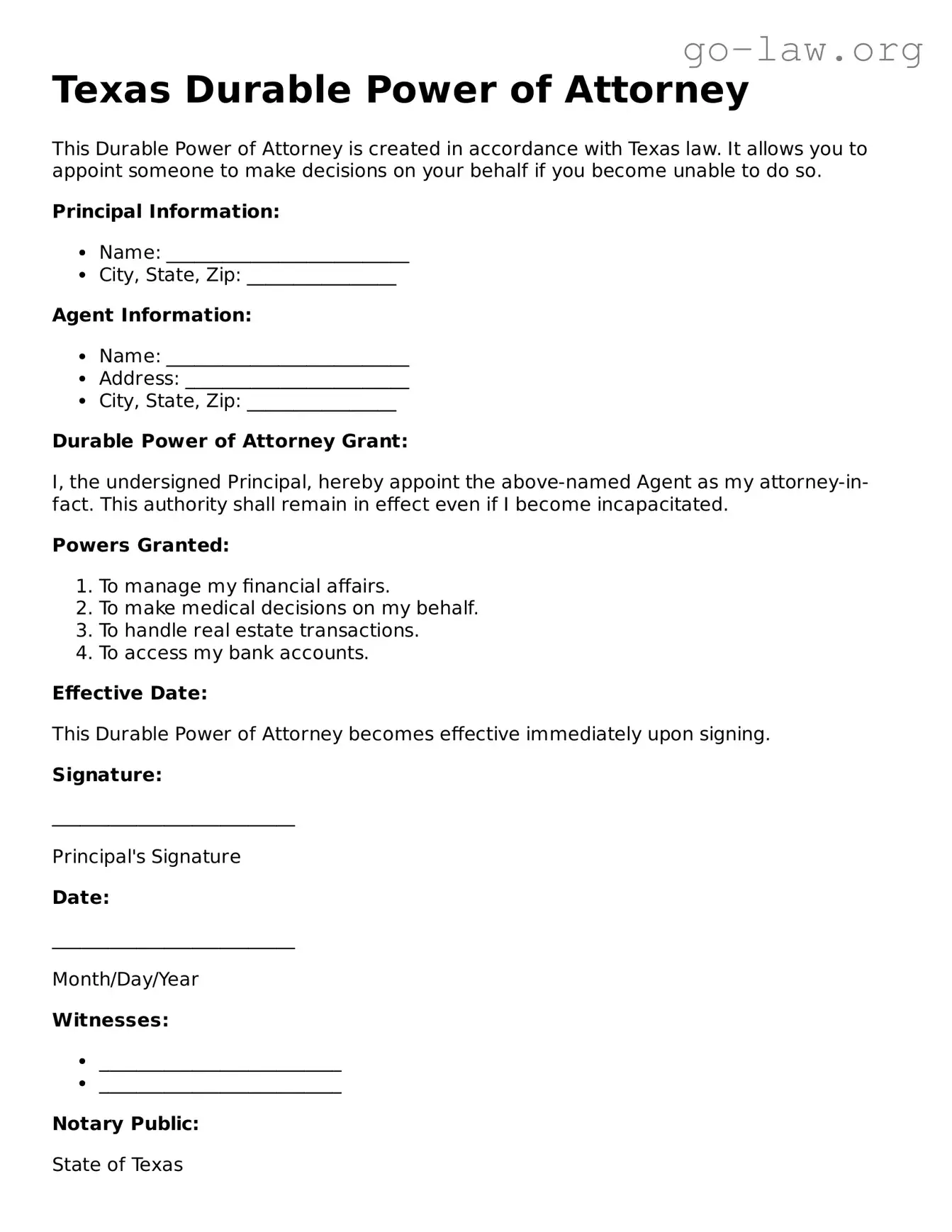
Texas Durable Power of Attorney
This Durable Power of Attorney is created in accordance with Texas law. It allows you to appoint someone to make decisions on your behalf if you become unable to do so.
Principal Information:
Agent Information:
Durable Power of Attorney Grant:
I, the undersigned Principal, hereby appoint the above-named Agent as my attorney-in-fact. This authority shall remain in effect even if I become incapacitated.
Powers Granted:
Effective Date:
This Durable Power of Attorney becomes effective immediately upon signing.
Signature:
__________________________
Principal's Signature
Date:
__________________________
Month/Day/Year
Witnesses:
Notary Public:
State of Texas
County of ____________________
Subscribed and sworn to before me this ____ day of __________, 20__.
__________________________
Notary Public Signature
My Commission Expires: __________
| Fact Name | Description |
|---|---|
| Definition | A Texas Durable Power of Attorney allows an individual to designate another person to manage their financial affairs, even if they become incapacitated. |
| Governing Law | The Texas Durable Power of Attorney is governed by the Texas Estates Code, specifically Title 2, Chapter 751. |
| Durability | This type of power of attorney remains effective even if the principal becomes incapacitated, unlike a regular power of attorney. |
| Agent's Authority | The agent can perform a variety of financial tasks, including managing bank accounts, paying bills, and making investment decisions. |
| Signing Requirements | The document must be signed by the principal and acknowledged by a notary public to be legally binding in Texas. |
| Revocation | The principal can revoke the durable power of attorney at any time, provided they are mentally competent. |
| Agent's Duties | The agent has a fiduciary duty to act in the best interest of the principal and must keep accurate records of transactions. |
| Limitations | While broad in scope, the power of attorney cannot authorize the agent to make healthcare decisions unless explicitly stated. |
Filling out the Texas Durable Power of Attorney form is a straightforward process. It’s important to ensure that all information is accurate and complete. Once you have filled out the form, you will need to sign it in front of a notary public for it to be valid.
A Texas Durable Power of Attorney is a legal document that allows you to appoint someone you trust to make financial and legal decisions on your behalf. This document remains effective even if you become incapacitated, ensuring that your affairs can be managed without interruption.
You can choose any competent adult as your agent, including a family member, friend, or professional such as an attorney. It is important to select someone who is responsible and trustworthy, as they will have significant authority over your financial matters.
The powers granted can vary based on your preferences. Common powers include:
You can specify which powers you want to include or exclude in the document.
To create a Durable Power of Attorney in Texas, you must:
Once completed, it is advisable to provide copies to your agent and any institutions that may need to recognize the document.
Yes, in Texas, the Durable Power of Attorney must be signed in the presence of a notary public to be legally valid. This requirement helps ensure that the document is authentic and that you were not coerced into signing.
Yes, you can revoke a Durable Power of Attorney at any time as long as you are competent. To revoke it, you should create a written revocation document and notify your agent and any relevant institutions that may have a copy of the original document.
If you become incapacitated, the Durable Power of Attorney remains effective. Your appointed agent can then make decisions on your behalf, ensuring that your financial and legal matters are handled according to your wishes.
Yes, the key difference lies in the durability. A regular Power of Attorney becomes invalid if you become incapacitated, while a Durable Power of Attorney continues to be effective under such circumstances. This distinction is crucial for long-term planning.
No, a Durable Power of Attorney typically covers financial and legal matters. If you want someone to make medical decisions on your behalf, you should consider creating a separate document known as a Medical Power of Attorney.
Once you have completed and notarized the Durable Power of Attorney, store it in a safe place. Provide copies to your agent, family members, and any financial institutions that may need to reference it. Keeping everyone informed helps ensure that your wishes are honored.
When filling out the Texas Durable Power of Attorney form, people often overlook important details. One common mistake is not specifying the powers granted. It is crucial to clearly outline what decisions the agent can make on your behalf. Without this clarity, there may be confusion or disputes later on.
Another frequent error is failing to sign the document in front of a notary. In Texas, a Durable Power of Attorney must be notarized to be valid. Skipping this step can lead to the entire document being deemed ineffective, which can cause significant issues when it is needed most.
Many individuals also forget to date the form. A missing date can create uncertainty about when the powers take effect. It is essential to include the date to ensure that the document is recognized and enforceable.
Some people neglect to discuss their choices with the person they are naming as their agent. This can lead to misunderstandings about the agent’s responsibilities. Having a conversation beforehand helps ensure that everyone is on the same page and agrees to the arrangement.
Another mistake is not reviewing the form carefully before submitting it. Errors in names, addresses, or other vital information can invalidate the document. Taking the time to double-check all details can prevent future complications.
People sometimes use outdated versions of the form. Laws and requirements can change, so it is important to use the most current version available. Using an old form may result in a document that does not meet current legal standards.
Additionally, individuals may not consider alternate agents. If the primary agent is unable or unwilling to act, having a backup can ensure that your wishes are still carried out. It is wise to name at least one alternate to avoid potential issues.
Some individuals fail to provide copies of the completed form to relevant parties. Once the document is signed and notarized, sharing it with your agent and any institutions they may need to interact with is essential. This ensures that everyone is informed and prepared to act when necessary.
Another common oversight is not revoking previous Durable Power of Attorney documents. If you create a new one, it is important to formally revoke any earlier versions. This prevents conflicting instructions and confusion about which document is valid.
Finally, people may underestimate the importance of regular reviews. Life circumstances can change, and so can your wishes. Regularly reviewing and updating your Durable Power of Attorney ensures it reflects your current preferences and needs.
When preparing a Texas Durable Power of Attorney, it is often beneficial to consider additional documents that can complement this important legal tool. These documents can provide further clarity and support in managing your affairs, ensuring that your wishes are respected and followed. Below are some commonly used forms that may be relevant.
Incorporating these documents alongside your Texas Durable Power of Attorney can create a comprehensive plan for your future. It is important to ensure that your wishes are clearly communicated and legally documented, providing peace of mind for both you and your loved ones.
The Texas Durable Power of Attorney (DPOA) form is similar to the General Power of Attorney (GPOA). Both documents allow an individual, known as the principal, to designate another person, referred to as the agent or attorney-in-fact, to make decisions on their behalf. The key difference lies in the durability; while the GPOA may become invalid if the principal becomes incapacitated, the DPOA remains effective even in such circumstances, ensuring that the agent can continue to act on behalf of the principal without interruption.
The Medical Power of Attorney (MPOA) serves a similar purpose but focuses specifically on healthcare decisions. This document allows the principal to appoint someone to make medical decisions if they are unable to do so themselves. Like the DPOA, the MPOA remains valid during periods of incapacity, ensuring that the appointed agent can make critical healthcare choices in line with the principal's wishes.
A Financial Power of Attorney (FPOA) is another document that shares similarities with the DPOA. This form grants the agent authority to manage financial matters, such as paying bills, managing investments, and handling real estate transactions. While the DPOA can encompass a broader range of powers, the FPOA is specifically tailored for financial decisions, often with clear limitations outlined by the principal.
The Springing Power of Attorney is similar to the DPOA in that it allows for the appointment of an agent. However, the authority granted to the agent in a Springing Power of Attorney only becomes effective under certain conditions, typically when the principal becomes incapacitated. This form provides a safeguard, ensuring that the agent's powers are activated only when truly necessary.
The Revocable Living Trust can also be compared to the DPOA, as both documents allow for the management of the principal's assets. However, the Revocable Living Trust is a legal entity that holds assets for the benefit of the principal during their lifetime and can be modified or revoked. In contrast, the DPOA is a directive that empowers an agent to act on behalf of the principal without creating a separate legal entity.
The Advance Healthcare Directive (AHD) shares similarities with the MPOA, as it encompasses both the appointment of a healthcare agent and the expression of the principal's healthcare preferences. This document allows individuals to outline their wishes regarding medical treatment and end-of-life care, ensuring that their values and desires are honored even when they cannot communicate them directly.
The Will, while primarily focused on the distribution of assets after death, can be viewed in relation to the DPOA in terms of decision-making authority. Both documents reflect the principal's wishes and intentions, but the Will takes effect upon death, whereas the DPOA is effective during the principal's lifetime, particularly in cases of incapacity.
Lastly, the Guardianship documents can be compared to the DPOA in that both involve the appointment of an individual to make decisions on behalf of another. However, guardianship is a court-ordered arrangement that typically arises when an individual is deemed unable to manage their affairs due to incapacity. The DPOA, on the other hand, is a voluntary agreement made by the principal, allowing them to choose their agent without court intervention.
When filling out the Texas Durable Power of Attorney form, it is essential to approach the task with care and attention to detail. The decisions made in this document can have significant implications for your financial and legal affairs. Below are some key guidelines to consider.
Understanding the Texas Durable Power of Attorney (DPOA) form is crucial for making informed decisions about your financial and medical affairs. However, several misconceptions often arise. Here are four common misunderstandings:
This is not true. Anyone, regardless of age, can benefit from having a DPOA. It’s a useful tool for anyone who wants to ensure their affairs are managed according to their wishes, especially in case of unexpected events.
While many people associate a DPOA with financial decisions, it can also cover medical decisions if specified. You can give your agent authority to make healthcare choices on your behalf.
This is a common concern, but a DPOA actually allows you to maintain control over your decisions. You designate someone you trust to act on your behalf, and you can specify the extent of their authority.
In reality, you can revoke a Durable Power of Attorney at any time, as long as you are mentally competent. This flexibility allows you to change your mind if your situation or trust in your agent changes.
The Texas Durable Power of Attorney form is an important legal document that allows an individual to designate someone else to make decisions on their behalf. Here are key takeaways regarding its use and completion:
Power of Attorney Form California - It is advisable to discuss the contents of the Durable Power of Attorney with family members to avoid misunderstandings.