Go Law
The California Quitclaim Deed form serves as a vital instrument in real estate transactions, allowing property owners to transfer their interest in a property to another individual or entity without making any warranties about the title. This form is particularly useful in situations where the granter may not be certain of the property’s history or when the parties involved have a high level of trust, such as family members or close friends. Unlike other deed types, a quitclaim deed does not guarantee that the title is free of liens or encumbrances, which means the grantee assumes the risk associated with the property. The form requires essential details, including the names of the granter and grantee, a legal description of the property, and the date of the transfer. Additionally, it must be signed by the granter in the presence of a notary public to ensure its validity. Understanding the nuances of the California Quitclaim Deed can empower individuals to navigate property transfers more confidently, providing a straightforward approach to convey ownership while minimizing potential disputes over title issues.
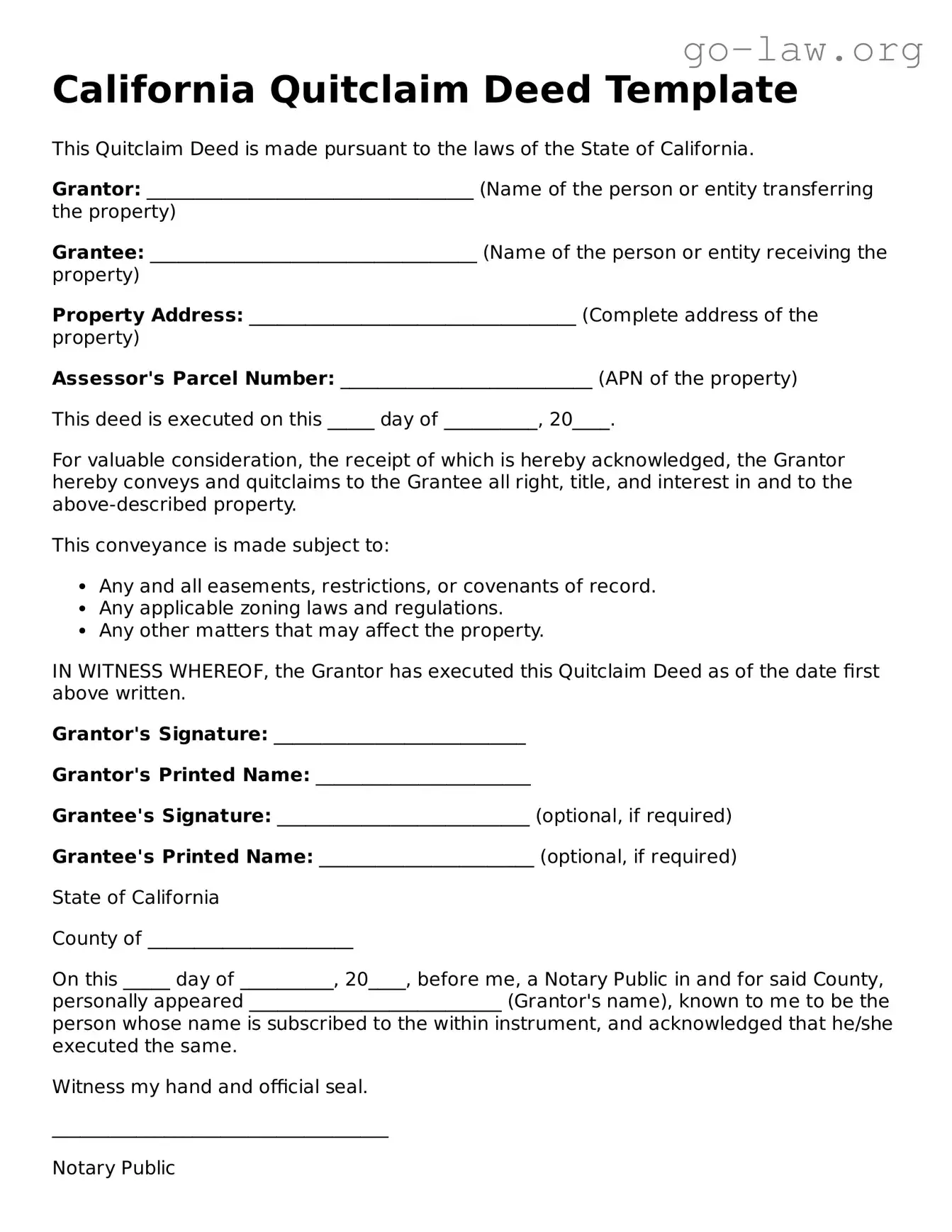
California Quitclaim Deed Template
This Quitclaim Deed is made pursuant to the laws of the State of California.
Grantor: ___________________________________ (Name of the person or entity transferring the property)
Grantee: ___________________________________ (Name of the person or entity receiving the property)
Property Address: ___________________________________ (Complete address of the property)
Assessor's Parcel Number: ___________________________ (APN of the property)
This deed is executed on this _____ day of __________, 20____.
For valuable consideration, the receipt of which is hereby acknowledged, the Grantor hereby conveys and quitclaims to the Grantee all right, title, and interest in and to the above-described property.
This conveyance is made subject to:
IN WITNESS WHEREOF, the Grantor has executed this Quitclaim Deed as of the date first above written.
Grantor's Signature: ___________________________
Grantor's Printed Name: _______________________
Grantee's Signature: ___________________________ (optional, if required)
Grantee's Printed Name: _______________________ (optional, if required)
State of California
County of ______________________
On this _____ day of __________, 20____, before me, a Notary Public in and for said County, personally appeared ___________________________ (Grantor's name), known to me to be the person whose name is subscribed to the within instrument, and acknowledged that he/she executed the same.
Witness my hand and official seal.
____________________________________
Notary Public
My Commission Expires: ______________
| Fact Name | Description |
|---|---|
| Definition | A Quitclaim Deed is a legal document used to transfer ownership of real property from one party to another without any warranties or guarantees. |
| Governing Law | The California Quitclaim Deed is governed by California Civil Code Section 2721 and related statutes. |
| Use Cases | This form is commonly used among family members, in divorce settlements, or to clear up title issues. |
| Recording Requirements | To be effective, the Quitclaim Deed must be signed, notarized, and recorded with the county recorder's office where the property is located. |
After gathering the necessary information, you can begin filling out the California Quitclaim Deed form. This process is straightforward, and following these steps will help ensure that you complete the form correctly.
A Quitclaim Deed is a legal document used to transfer ownership of real property from one party to another without any warranties or guarantees. In California, this type of deed is often used among family members, during divorce proceedings, or when clearing up title issues. It essentially conveys whatever interest the grantor has in the property, if any, to the grantee.
Quitclaim Deeds are commonly used in various situations, including:
It is important to note that a Quitclaim Deed does not guarantee that the property is free of liens or other encumbrances.
To complete a Quitclaim Deed in California, follow these steps:
While it is not legally required to hire a lawyer to prepare a Quitclaim Deed, it may be beneficial in certain situations. If the property has complex title issues or if the transfer involves significant assets, consulting with a legal professional can provide peace of mind and ensure that all legal requirements are met.
No, a Quitclaim Deed is not the same as a Warranty Deed. A Warranty Deed provides guarantees and assurances about the property’s title, ensuring that the grantor has clear ownership and the right to sell. In contrast, a Quitclaim Deed offers no such assurances, simply transferring whatever interest the grantor may have.
Generally, transferring property through a Quitclaim Deed may have tax implications, such as reassessment of property taxes. In California, the transfer may trigger Proposition 13 reassessment rules, which could affect the property tax rate. It is advisable to consult a tax professional to understand the specific implications for your situation.
Once a Quitclaim Deed is executed and recorded, it cannot be revoked unilaterally. However, if both parties agree, they can execute a new document to reverse the transfer. Additionally, if there are grounds for fraud or misrepresentation, legal action may be pursued to contest the deed.
If the grantor has no ownership interest in the property, the Quitclaim Deed will still transfer whatever interest they may have, which could be nothing. This means that the grantee receives no rights to the property. It is crucial to verify the grantor's ownership status before executing a Quitclaim Deed.
The cost to file a Quitclaim Deed varies by county in California. Typically, there is a recording fee that can range from $10 to $50 or more, depending on the county's regulations. It is advisable to check with the local county recorder's office for specific fees and requirements.
Quitclaim Deed forms can be obtained from various sources, including:
Ensure that the form you obtain complies with California state laws and includes all necessary information.
Filling out a California Quitclaim Deed form can seem straightforward, but several common mistakes can lead to complications. One frequent error is failing to include the correct names of the parties involved. The grantor (the person transferring the property) and the grantee (the person receiving the property) must be clearly identified. Omitting or misspelling names can create legal issues down the line.
Another common mistake is neglecting to provide a complete legal description of the property. This description should accurately reflect the property's boundaries and characteristics. Incomplete or vague descriptions can result in disputes regarding property ownership.
Many individuals also overlook the necessity of notarization. A Quitclaim Deed must be signed in front of a notary public to be legally valid. Failing to have the deed notarized can render it unenforceable, leading to potential ownership challenges.
People often forget to include the date of execution. This date is crucial as it establishes when the transfer of property takes effect. Without it, the deed may lack clarity regarding the timing of the transaction.
Another mistake is not providing the appropriate tax information. In California, certain tax implications may arise from property transfers. Failing to include this information can lead to unexpected tax liabilities for the grantee.
Additionally, individuals sometimes forget to record the Quitclaim Deed with the county recorder’s office. Recording the deed is essential for public notice and helps protect the grantee's ownership rights. Without this step, the transfer may not be recognized in legal contexts.
Some people also fail to review the deed for accuracy before submission. Errors in the document can lead to delays or rejection by the county recorder. A thorough review ensures that all information is correct and complete.
Lastly, individuals may not understand the implications of using a Quitclaim Deed compared to other types of property transfer methods. While a Quitclaim Deed can be a quick way to transfer property, it does not guarantee that the grantor has clear title. This lack of warranty can lead to future disputes over property rights.
When preparing to execute a California Quitclaim Deed, it is essential to consider several other forms and documents that may be necessary to ensure a smooth transaction. Each of these documents serves a specific purpose and can help clarify the details of the property transfer. Below is a list of commonly used forms that accompany a Quitclaim Deed.
Understanding these accompanying documents can significantly ease the process of transferring property ownership. Each form plays a vital role in ensuring that the transaction is legally sound and that all parties involved are protected. It is advisable to consult with a professional if you have questions or need assistance with any of these documents.
A Grant Deed is often compared to a Quitclaim Deed. While both documents transfer property ownership, a Grant Deed includes warranties that the property is free from encumbrances. In contrast, a Quitclaim Deed offers no such guarantees. This makes the Grant Deed a safer option for buyers, as it provides some assurance regarding the title's status.
A Warranty Deed is another document similar to a Quitclaim Deed. Like the Grant Deed, a Warranty Deed guarantees that the seller holds clear title to the property and has the right to sell it. The key difference lies in the level of protection offered. A Warranty Deed provides the highest level of assurance to the buyer, while a Quitclaim Deed does not offer any warranties, making it a riskier choice for buyers.
An Easement Deed is also related to property transactions. This document grants a specific right to use a portion of someone else's property for a particular purpose, such as access or utilities. Unlike a Quitclaim Deed, which transfers ownership, an Easement Deed allows for shared use while retaining ownership of the property. This distinction is crucial for understanding the rights involved in property use.
A Deed of Trust is another relevant document. It involves three parties: the borrower, the lender, and the trustee. In this arrangement, the borrower conveys the property to the trustee as security for a loan. While a Quitclaim Deed transfers ownership outright, a Deed of Trust creates a security interest in the property, which can be foreclosed upon if the borrower defaults.
A Special Warranty Deed is similar to a Quitclaim Deed but offers limited warranties. The seller guarantees that they have not encumbered the property during their ownership. This is different from a Quitclaim Deed, which makes no guarantees at all. Buyers may find a Special Warranty Deed to be a middle ground between the risks of a Quitclaim Deed and the protections of a full Warranty Deed.
A Bargain and Sale Deed is also noteworthy. This document implies that the seller has the right to sell the property but does not provide any warranties regarding the title. Like a Quitclaim Deed, it transfers ownership without assurances. Buyers should be cautious, as this type of deed may expose them to potential title issues.
A Certificate of Title is not a deed but serves a related purpose. It is an official document issued by a title company that verifies the ownership of a property and outlines any liens or encumbrances. While a Quitclaim Deed transfers ownership, a Certificate of Title provides important information about the property's status, helping buyers make informed decisions.
A Release of Lien is another document that can be compared to a Quitclaim Deed. It removes a lien from a property, indicating that the debt has been satisfied. While a Quitclaim Deed transfers ownership, a Release of Lien ensures that the property is free from specific financial claims. Both documents play a role in clarifying property rights but serve different functions in the transfer process.
Finally, a Property Settlement Agreement is similar in that it involves the division of property rights, often during divorce proceedings. This document outlines how property will be divided between parties. While a Quitclaim Deed transfers ownership outright, a Property Settlement Agreement specifies how ownership and rights will be allocated, making it a vital tool in resolving disputes.
When filling out the California Quitclaim Deed form, attention to detail is crucial. Here are eight essential dos and don'ts to guide you through the process.
When it comes to real estate transactions in California, the Quitclaim Deed form often generates a lot of confusion. Here are ten common misconceptions about this important legal document:
Many people believe that a quitclaim deed transfers ownership of a property without any issues. In reality, it only transfers whatever interest the grantor has in the property, which could be none at all.
While quitclaim deeds are often used in divorce settlements, they are also useful for many other situations, such as transferring property between family members or adding a spouse to a title.
Some believe that using a quitclaim deed can clear any existing liens on the property. However, this is not true. Liens remain attached to the property, regardless of the deed used.
This misconception suggests that quitclaim deeds can only be used for homes. In fact, they can be used for any type of real estate, including commercial properties and land.
People often think that quitclaim deeds are final and unchangeable. However, if both parties agree, they can execute a new deed to reverse or modify the transaction.
Many confuse quitclaim deeds with warranty deeds. Unlike a warranty deed, a quitclaim deed does not guarantee that the grantor has a valid title to the property.
While notarization is highly recommended for a quitclaim deed to be accepted by the county, it is not strictly required for the deed to be legally valid.
Although quitclaim deeds are typically recorded with the county, they are not automatically public records. Certain conditions can affect their visibility to the public.
While the process may seem straightforward, using a quitclaim deed can lead to complications, especially if there are disputes about ownership or if the property has encumbrances.
Although they are commonly used within families, quitclaim deeds can be used for transactions between unrelated parties as well.
Understanding these misconceptions can help individuals make informed decisions when dealing with property transfers in California. Always consider consulting a legal professional for guidance tailored to your specific situation.
When dealing with a California Quitclaim Deed form, it's important to understand the key elements involved. Here are some essential takeaways:
Understanding these points can help ensure a smooth process when filling out and using a Quitclaim Deed in California.
What Is a Quit Claim Deed in Florida - A quitclaim deed can be used to transfer property rights for tax purposes.
How to File a Quitclaim Deed in Texas - A Quitclaim Deed is not suitable for selling property to a stranger.
Quitclaim Deed Attorney - It’s important to ensure that the person giving the Quitclaim has the right to do so.