Go Law
The Florida Quitclaim Deed form serves as a vital tool for transferring property rights in a straightforward manner. This form allows an individual, known as the grantor, to convey their interest in real estate to another party, referred to as the grantee, without making any guarantees about the property’s title. Often used among family members or in situations where the parties know each other well, the quitclaim deed is favored for its simplicity and efficiency. The document typically includes essential details such as the names of both the grantor and grantee, a legal description of the property, and the date of the transfer. Importantly, it must be signed by the grantor in the presence of a notary public to ensure its validity. While the quitclaim deed does not protect the grantee against potential claims or liens on the property, it can be a quick solution for transferring ownership, especially when the parties involved trust one another. Understanding the nuances of this form is crucial for anyone considering a property transfer in Florida.
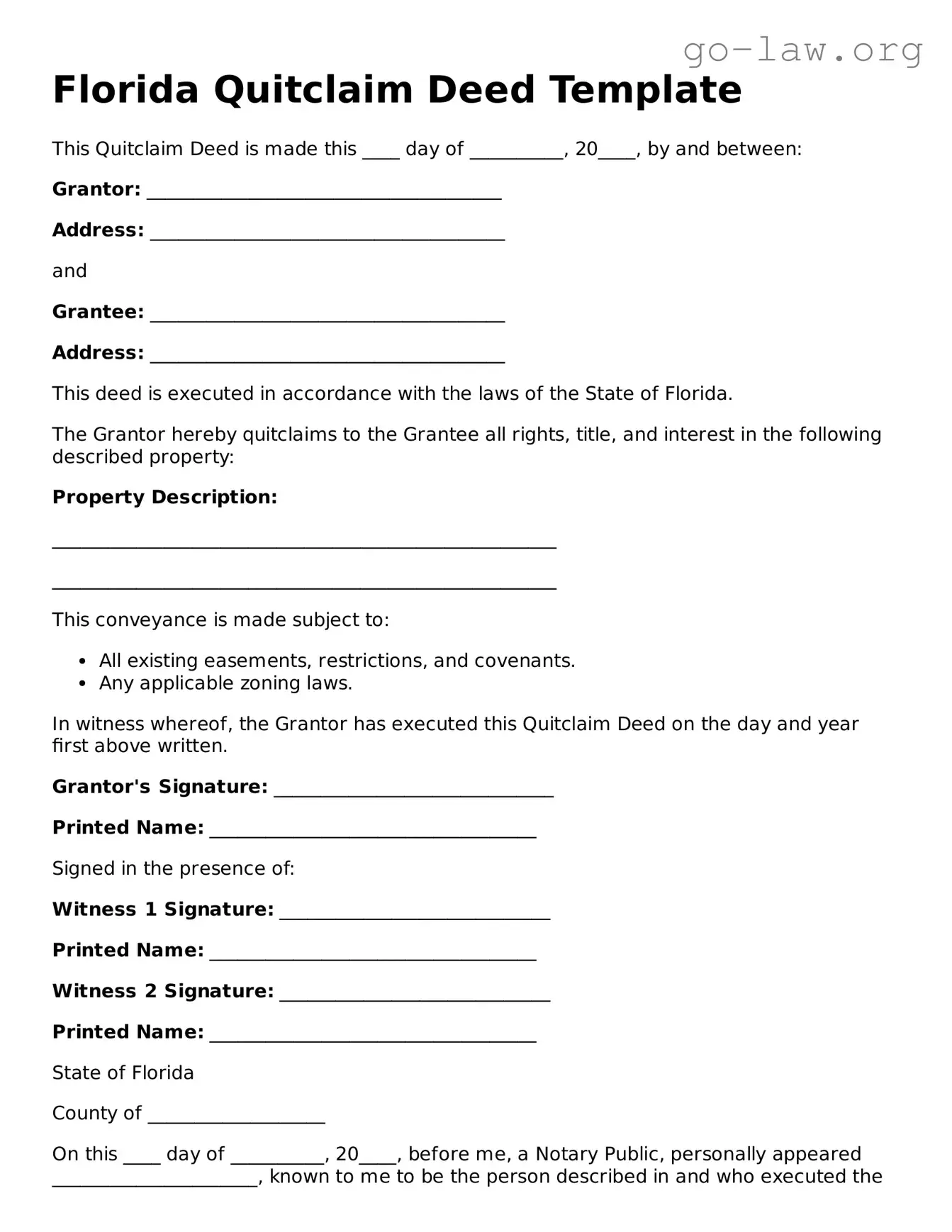
Florida Quitclaim Deed Template
This Quitclaim Deed is made this ____ day of __________, 20____, by and between:
Grantor: ______________________________________
Address: ______________________________________
and
Grantee: ______________________________________
Address: ______________________________________
This deed is executed in accordance with the laws of the State of Florida.
The Grantor hereby quitclaims to the Grantee all rights, title, and interest in the following described property:
Property Description:
______________________________________________________
______________________________________________________
This conveyance is made subject to:
In witness whereof, the Grantor has executed this Quitclaim Deed on the day and year first above written.
Grantor's Signature: ______________________________
Printed Name: ___________________________________
Signed in the presence of:
Witness 1 Signature: _____________________________
Printed Name: ___________________________________
Witness 2 Signature: _____________________________
Printed Name: ___________________________________
State of Florida
County of ___________________
On this ____ day of __________, 20____, before me, a Notary Public, personally appeared ______________________, known to me to be the person described in and who executed the foregoing instrument.
Notary Public Signature: ___________________________
Printed Name: ___________________________________
My Commission Expires: ___________________________
| Fact Name | Details |
|---|---|
| Definition | A Florida Quitclaim Deed transfers ownership of property without guaranteeing the title's validity. |
| Governing Law | Florida Statutes, Chapter 689. |
| Use Case | Commonly used among family members or in divorce settlements to transfer property rights. |
| Filing Requirements | The deed must be signed, notarized, and filed with the county clerk for it to be effective. |
Once the Florida Quitclaim Deed form is completed, it must be signed and notarized before it can be submitted for recording with the appropriate county office. It is essential to ensure that all information is accurate and clearly written to avoid any delays in processing.
A Florida Quitclaim Deed is a legal document used to transfer ownership of real estate from one party to another without making any guarantees about the property’s title. This type of deed is often used among family members or in situations where the parties know each other well. It essentially allows the grantor to relinquish any claim they may have to the property, but it does not ensure that the title is clear or free of liens.
Quitclaim Deeds are commonly used in various scenarios, including:
However, it is not advisable to use a Quitclaim Deed when purchasing property from a stranger, as this does not provide any protection regarding the title's condition.
To complete a Quitclaim Deed in Florida, follow these steps:
While it is not legally required to have a lawyer prepare a Quitclaim Deed, consulting with one is often beneficial. A legal expert can ensure that the deed is completed correctly, that all necessary information is included, and that it complies with Florida law. This can help prevent future disputes or issues related to the property title.
In Florida, transferring property via a Quitclaim Deed may trigger documentary stamp taxes. The amount of tax depends on the value of the property being transferred. Generally, the grantor is responsible for paying these taxes, but parties can negotiate who will cover the cost. It is advisable to check with a tax professional or local tax office to understand the specific implications.
Once a Quitclaim Deed is executed and recorded, it cannot be revoked unilaterally. The grantor relinquishes their rights to the property at the time of the transfer. However, if the parties agree, they may create a new deed to reverse the transfer, but this is subject to the acceptance of the grantee. Always consult legal advice if considering reversing a deed transfer.
A Quitclaim Deed does not clear any existing liens or encumbrances on the property. If there are outstanding debts or claims against the property, the grantee assumes responsibility for those upon receiving the property. It is crucial to conduct a title search before executing a Quitclaim Deed to understand any potential issues that may affect ownership.
Filling out a Florida Quitclaim Deed form can be straightforward, but many people make common mistakes that can lead to complications. One frequent error is neglecting to include the correct names of the parties involved. The grantor and grantee must be clearly identified. If the names are misspelled or not listed in full, it can create confusion and potentially invalidate the deed.
Another mistake often seen is failing to provide a proper legal description of the property. A vague or incomplete description can lead to disputes later on. It is essential to include the exact parcel number or a detailed description that accurately reflects the property being transferred.
People sometimes overlook the need for notarization. A Quitclaim Deed must be signed in front of a notary public to be legally binding. Without this step, the document may not be recognized by the county clerk or other authorities.
Additionally, many individuals forget to check the recording requirements. After completing the Quitclaim Deed, it must be filed with the appropriate county office. Failing to do so means the transfer may not be officially recognized, leaving the property still tied to the previous owner.
Another common pitfall is not understanding the implications of the deed. A Quitclaim Deed transfers ownership without any warranties. This means that the grantor is not guaranteeing that the title is clear. Buyers should be aware of this risk and may want to conduct a title search before proceeding.
People also sometimes neglect to consider tax implications. Transferring property can have tax consequences, including documentary stamp taxes in Florida. It's crucial to consult with a tax professional to understand any potential liabilities.
Inaccurate or missing signatures can lead to issues as well. Each party involved must sign the deed, and if any signature is missing, the document may be deemed invalid. This can create significant delays in the transfer process.
Lastly, many fail to retain copies of the completed Quitclaim Deed. Keeping a copy is essential for future reference and can help resolve any disputes that may arise. Without a copy, proving ownership or the terms of the transfer can become complicated.
When transferring property in Florida, the Quitclaim Deed is a vital document. However, several other forms and documents often accompany it to ensure a smooth transaction and to comply with legal requirements. Below is a list of these important documents, each serving a unique purpose.
Each of these documents plays a critical role in the property transfer process. Ensuring that you have all necessary forms prepared and reviewed can help avoid complications down the road. It is advisable to consult with a professional to ensure compliance with all local laws and regulations.
A Warranty Deed is similar to a Quitclaim Deed in that both documents transfer ownership of real property. However, a Warranty Deed provides a guarantee that the seller holds clear title to the property and has the right to sell it. This means that the seller is responsible for any claims against the property. In contrast, a Quitclaim Deed offers no such guarantees, making it a riskier option for the buyer.
A Bargain and Sale Deed is another document that shares similarities with the Quitclaim Deed. This type of deed implies that the seller has title to the property and the right to sell it, but it does not provide any warranties against encumbrances. Like a Quitclaim Deed, it transfers ownership but offers less protection to the buyer compared to a Warranty Deed.
A Special Purpose Deed, such as a Deed in Lieu of Foreclosure, can also resemble a Quitclaim Deed. This document allows a borrower to transfer property to the lender to avoid foreclosure. While a Quitclaim Deed is typically used between private parties, a Special Purpose Deed often involves financial institutions and may include specific terms related to the debt being settled.
An Executor’s Deed is used when property is transferred from a deceased person's estate. Similar to a Quitclaim Deed, it does not provide warranties regarding the title. The executor of the estate conveys the property to the heirs or beneficiaries, often without guaranteeing that the title is free from defects.
A Trustee’s Deed is issued when a property is transferred by a trustee, often in the context of a trust or bankruptcy. Like a Quitclaim Deed, it transfers ownership without warranties. This type of deed is commonly used in estate planning and asset management, allowing for a straightforward transfer of property interests.
A Mineral Deed is specific to the transfer of mineral rights associated with a property. While it serves a different purpose than a Quitclaim Deed, it shares the characteristic of transferring ownership without warranties. This means that the buyer must accept the risks related to the mineral rights being conveyed.
A Bill of Sale is often used for personal property rather than real estate but can be likened to a Quitclaim Deed in its function of transferring ownership. A Bill of Sale does not guarantee that the seller has clear title to the item being sold, similar to how a Quitclaim Deed operates for real property. Both documents facilitate the transfer of ownership with minimal formalities.
An Affidavit of Title may also resemble a Quitclaim Deed in some respects. This document is used to declare the ownership of a property and can accompany a Quitclaim Deed. While it does not transfer title, it provides a statement regarding the seller's ownership, similar to the intentions behind a Quitclaim Deed.
A Leasehold Deed, which conveys a leasehold interest in a property, can be compared to a Quitclaim Deed. Both documents transfer rights related to property, but a Leasehold Deed grants temporary rights rather than outright ownership. The similarities lie in the transfer process, though the nature of the rights being conveyed differs significantly.
Lastly, a Power of Attorney can be seen as similar in that it allows one person to act on behalf of another in property transactions. While it does not transfer ownership itself, it can authorize someone to execute a Quitclaim Deed on behalf of the property owner. This connection highlights the role of legal documents in facilitating property transactions, even if their purposes differ.
When filling out the Florida Quitclaim Deed form, attention to detail is crucial. Here’s a straightforward list of things you should and shouldn't do:
By following these guidelines, you can help ensure that the process goes smoothly and that your deed is valid. Take your time and review the document carefully before submission.
Understanding the Florida Quitclaim Deed can be challenging due to several misconceptions. Here are eight common misunderstandings about this legal document:
By understanding these misconceptions, individuals can make more informed decisions regarding property transfers in Florida. Always consider seeking professional advice when dealing with legal documents.
When considering the use of a Florida Quitclaim Deed form, it is essential to understand its purpose and the process involved. Below are key takeaways to keep in mind:
Quitclaim Deed Attorney - It’s a straightforward way to document the transfer of property rights.