Go Law
When it comes to transferring property in Georgia, the Quitclaim Deed form stands out as a straightforward and efficient option. This legal document allows an individual, known as the grantor, to convey their interest in real estate to another person, referred to as the grantee, without making any guarantees about the property's title. Unlike other types of deeds, a Quitclaim Deed does not provide warranties, meaning the grantee receives whatever interest the grantor may have, if any at all. This makes it particularly useful in situations such as transferring property between family members, settling estates, or correcting title issues. The form typically includes essential details such as the names of both parties, a description of the property, and the date of transfer. While the process may seem simple, understanding the implications of using a Quitclaim Deed is crucial for anyone involved in property transactions. Whether you are a seasoned real estate investor or a first-time homebuyer, knowing how to properly utilize this form can help you navigate the complexities of property ownership with confidence.
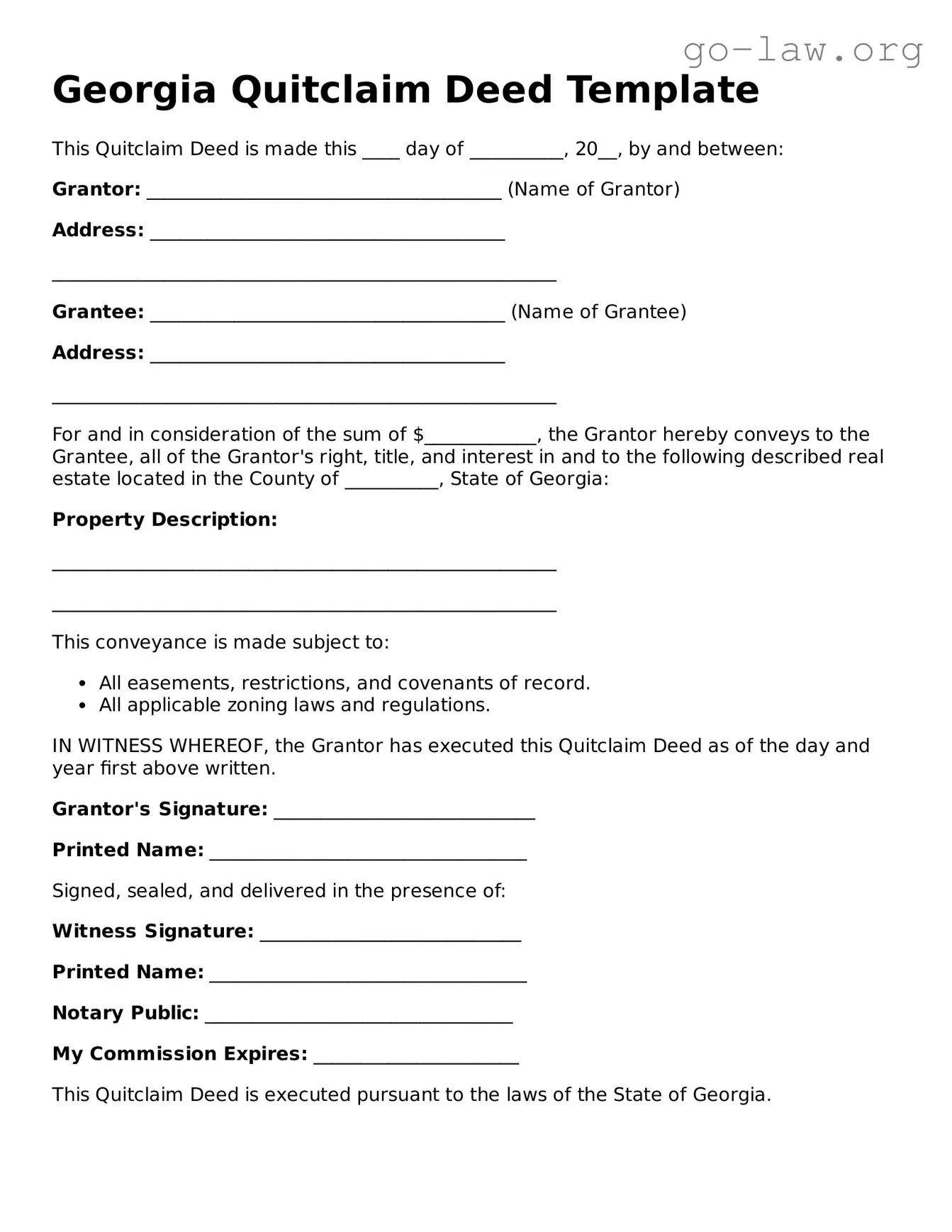
Georgia Quitclaim Deed Template
This Quitclaim Deed is made this ____ day of __________, 20__, by and between:
Grantor: ______________________________________ (Name of Grantor)
Address: ______________________________________
______________________________________________________
Grantee: ______________________________________ (Name of Grantee)
Address: ______________________________________
______________________________________________________
For and in consideration of the sum of $____________, the Grantor hereby conveys to the Grantee, all of the Grantor's right, title, and interest in and to the following described real estate located in the County of __________, State of Georgia:
Property Description:
______________________________________________________
______________________________________________________
This conveyance is made subject to:
IN WITNESS WHEREOF, the Grantor has executed this Quitclaim Deed as of the day and year first above written.
Grantor's Signature: ____________________________
Printed Name: __________________________________
Signed, sealed, and delivered in the presence of:
Witness Signature: ____________________________
Printed Name: __________________________________
Notary Public: _________________________________
My Commission Expires: ______________________
This Quitclaim Deed is executed pursuant to the laws of the State of Georgia.
| Fact Name | Description |
|---|---|
| Definition | A Quitclaim Deed in Georgia transfers ownership interest in a property without guaranteeing that the title is clear. |
| Governing Law | The use of Quitclaim Deeds in Georgia is governed by Title 44, Chapter 5 of the Official Code of Georgia Annotated (O.C.G.A.). |
| Requirements | The form must be signed by the grantor and notarized. It should also include a legal description of the property. |
| Filing | After execution, the Quitclaim Deed should be filed with the county clerk's office where the property is located. |
After completing the Georgia Quitclaim Deed form, the next step involves ensuring that the document is properly executed and recorded with the appropriate county office. This process is crucial for the transfer of property rights to be legally recognized.
A Quitclaim Deed is a legal document used to transfer ownership of property from one person to another. In Georgia, this type of deed does not guarantee that the person transferring the property has clear title to it. Instead, it simply conveys whatever interest the grantor has in the property, if any. This makes it a useful tool in certain situations, such as transferring property between family members or clearing up title issues.
Completing a Quitclaim Deed involves several steps:
While it is not legally required to have a lawyer prepare a Quitclaim Deed, consulting with one can be beneficial. A lawyer can ensure that the deed is completed correctly and that all necessary information is included. This can help prevent future disputes or issues related to the property transfer.
There are several advantages to using a Quitclaim Deed:
Yes, there are some disadvantages to consider:
No, a Quitclaim Deed is not the same as a Warranty Deed. A Warranty Deed provides guarantees about the title, ensuring that the grantor has clear ownership and the right to sell the property. In contrast, a Quitclaim Deed simply transfers whatever interest the grantor has, without any assurances about the title.
Once a Quitclaim Deed is executed and recorded, it cannot be revoked unilaterally. However, the parties involved can agree to a new deed or a different arrangement if they wish to reverse the transfer. It is important to document any such agreements properly to avoid future disputes.
Filling out a Georgia Quitclaim Deed form can be straightforward, but many people make mistakes that could lead to complications later. One common error is not including the correct legal description of the property. The legal description must be precise and accurately reflect the property being transferred. If this information is incorrect or incomplete, it can create confusion and potentially invalidate the deed.
Another frequent mistake is failing to sign the deed properly. All parties involved in the transfer must sign the document. If one signature is missing, the deed may not be recognized by the county. Additionally, signatures must be notarized. Without notarization, the deed lacks the necessary legal weight and could be challenged in the future.
People often overlook the importance of including the correct names of the grantor and grantee. The names should match exactly as they appear on legal documents. Misspellings or incorrect names can lead to issues with ownership rights. It is crucial to double-check this information to ensure a smooth transfer of property.
Lastly, many individuals forget to file the Quitclaim Deed with the appropriate county office. After completing the form, it must be submitted to the county where the property is located. Failing to file the deed means the transfer is not officially recorded, which can create problems for future transactions or disputes regarding ownership.
When completing a property transfer in Georgia, the Quitclaim Deed is a crucial document. However, several other forms and documents are often necessary to ensure a smooth transaction. Below is a list of common documents that may accompany a Quitclaim Deed.
Understanding these accompanying documents can simplify the property transfer process and ensure that all necessary steps are taken for a successful transaction. It is advisable to consult with a professional to ensure compliance with local laws and regulations.
A Warranty Deed is a document that conveys ownership of real property and guarantees that the seller has clear title to the property. Unlike a Quitclaim Deed, which offers no warranties about the title, a Warranty Deed assures the buyer that the seller will defend against any claims to the title. This added protection makes it a preferred choice for buyers who seek certainty regarding their ownership rights.
A Bargain and Sale Deed transfers property without any warranties against encumbrances. Similar to a Quitclaim Deed, it conveys ownership but does not guarantee that the title is free of defects. This type of deed is often used in transactions where the seller may not be able to provide a Warranty Deed, making it a middle ground between a Quitclaim and a Warranty Deed.
An Executor's Deed is used to transfer property from a deceased person's estate. This document is similar to a Quitclaim Deed in that it does not provide warranties about the title. Instead, it allows the executor of the estate to transfer property to heirs or beneficiaries, facilitating the distribution of assets after death.
A Trustee's Deed is executed by a trustee, typically in the context of a trust. Like a Quitclaim Deed, it transfers property without warranties. This document is often used when property is held in a trust and needs to be conveyed to beneficiaries or sold, emphasizing the role of the trustee in managing the property.
A Special Warranty Deed is similar to a Warranty Deed but limits the seller's liability to only the time they owned the property. It provides some assurances to the buyer about the title, unlike a Quitclaim Deed, which offers no such guarantees. This type of deed is often used in commercial real estate transactions.
A Deed in Lieu of Foreclosure allows a homeowner to transfer property back to the lender to avoid foreclosure. This document shares similarities with a Quitclaim Deed as it relinquishes ownership without warranties. It serves as a means for the homeowner to mitigate the financial consequences of foreclosure while simplifying the process for the lender.
An Affidavit of Title is not a deed but is often used in conjunction with property transfers. It is a sworn statement by the seller affirming their ownership and the status of the title. While it does not transfer property like a Quitclaim Deed, it provides important information about the title, enhancing transparency in real estate transactions.
When filling out the Georgia Quitclaim Deed form, it is essential to approach the process with care and attention to detail. Below is a list of things you should and shouldn't do to ensure that your deed is completed correctly.
By following these guidelines, you can help ensure that your Quitclaim Deed is processed smoothly and legally. Taking the time to complete the form accurately will protect your interests and those of the other parties involved.
When dealing with real estate transactions in Georgia, the Quitclaim Deed form often comes up. However, there are several misconceptions surrounding it. Here are eight common misunderstandings:
Understanding these misconceptions can help individuals make informed decisions when dealing with real estate transactions in Georgia.
Filling out and using a Georgia Quitclaim Deed form can be straightforward, but it's important to understand the key aspects involved. Here are nine essential takeaways to guide you through the process:
By keeping these points in mind, you can navigate the Quitclaim Deed process in Georgia with greater confidence and clarity.
What Is a Quit Claim Deed in Florida - It does not involve a title search or title insurance in most cases.
How to File a Quitclaim Deed in Texas - A Quitclaim Deed can be used to add or remove a name from a title.
How Much Is a Quitclaim Deed - They are often used in real estate transactions involving foreclosures or short sales.