Go Law
In Texas, the Quitclaim Deed form serves as a crucial legal tool for transferring property ownership without guaranteeing the title's validity. This form is particularly useful in situations such as divorce settlements, family transfers, or when one party wishes to relinquish their interest in a property. Unlike warranty deeds, a quitclaim deed does not provide any assurances about the property’s title, meaning the grantor simply conveys whatever interest they may have, if any. This lack of warranty makes it essential for both parties to understand the implications of the transfer. The form typically includes essential details such as the names of the grantor and grantee, a legal description of the property, and the signatures of the involved parties. Additionally, it must be filed with the county clerk to ensure the transaction is legally recognized. Understanding the Quitclaim Deed is vital for anyone looking to navigate property transfers in Texas effectively.
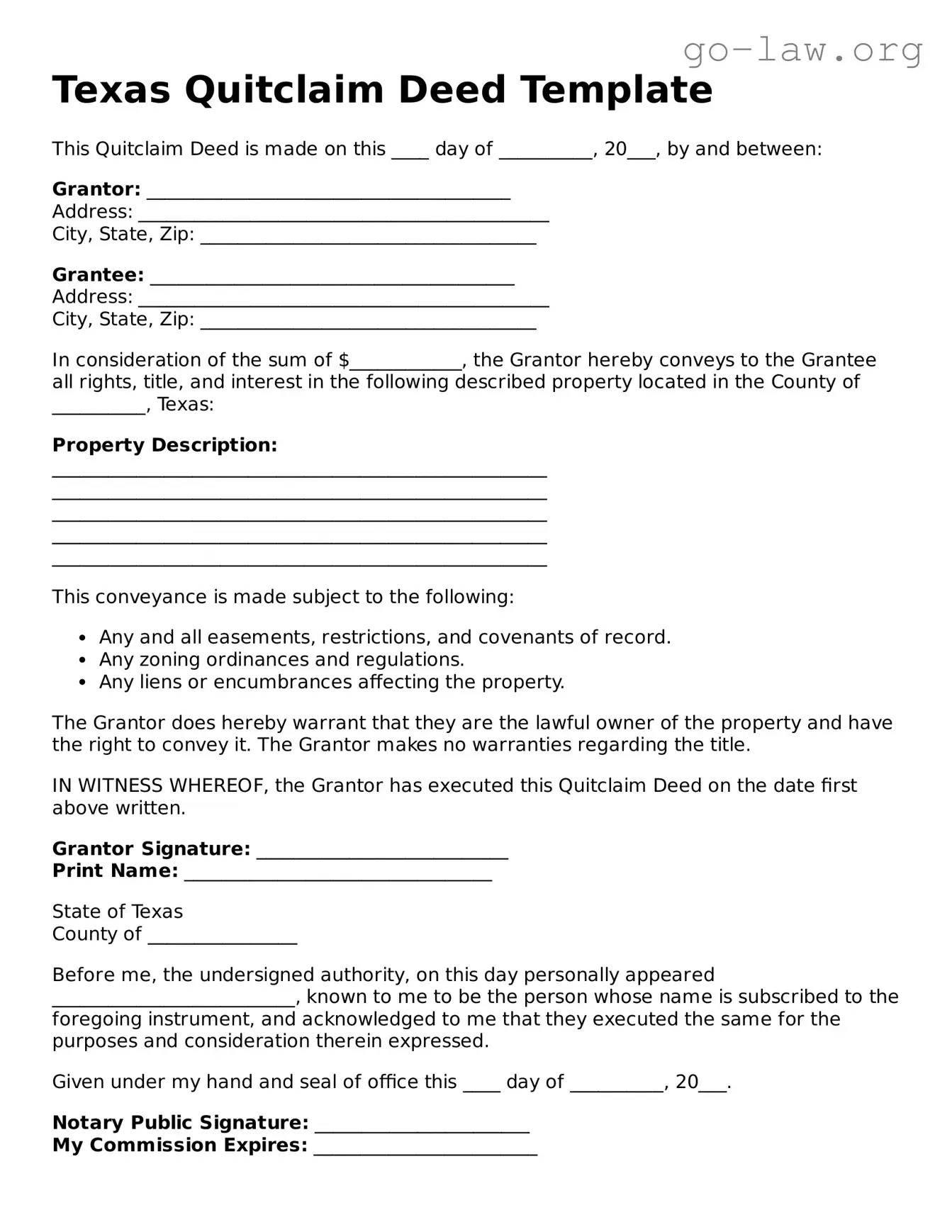
Texas Quitclaim Deed Template
This Quitclaim Deed is made on this ____ day of __________, 20___, by and between:
Grantor: _______________________________________
Address: ____________________________________________
City, State, Zip: ____________________________________
Grantee: _______________________________________
Address: ____________________________________________
City, State, Zip: ____________________________________
In consideration of the sum of $____________, the Grantor hereby conveys to the Grantee all rights, title, and interest in the following described property located in the County of __________, Texas:
Property Description:
_____________________________________________________
_____________________________________________________
_____________________________________________________
_____________________________________________________
_____________________________________________________
This conveyance is made subject to the following:
The Grantor does hereby warrant that they are the lawful owner of the property and have the right to convey it. The Grantor makes no warranties regarding the title.
IN WITNESS WHEREOF, the Grantor has executed this Quitclaim Deed on the date first above written.
Grantor Signature: ___________________________
Print Name: _________________________________
State of Texas
County of ________________
Before me, the undersigned authority, on this day personally appeared __________________________, known to me to be the person whose name is subscribed to the foregoing instrument, and acknowledged to me that they executed the same for the purposes and consideration therein expressed.
Given under my hand and seal of office this ____ day of __________, 20___.
Notary Public Signature: _______________________
My Commission Expires: ________________________
| Fact Name | Description |
|---|---|
| Definition | A Texas Quitclaim Deed transfers ownership of property without guaranteeing the title. |
| Purpose | It is often used to clear up title issues or transfer property between family members. |
| Governing Law | The Texas Property Code governs the use of Quitclaim Deeds in Texas. |
| Requirements | The deed must include the names of the grantor and grantee, a legal description of the property, and be signed by the grantor. |
| Recording | To protect the interests of the grantee, the deed should be recorded at the county clerk's office where the property is located. |
| Consideration | Consideration, or payment, is not required, but a nominal amount is often included. |
| Tax Implications | Property transfers via Quitclaim Deeds may have tax implications; consult a tax professional for guidance. |
| Limitations | This deed does not guarantee that the grantor has a valid title or that the property is free from liens. |
| Use Cases | Commonly used in divorce settlements, estate transfers, and to add or remove names from property titles. |
Once you have the Texas Quitclaim Deed form, it's time to complete it accurately. This document will transfer ownership of property from one party to another. Ensure all information is correct before submission to avoid any delays.
A Texas Quitclaim Deed is a legal document used to transfer ownership of real estate from one party to another. Unlike a warranty deed, a quitclaim deed does not guarantee that the property is free of liens or other claims. It simply conveys whatever interest the grantor has in the property, if any.
Quitclaim deeds are often used in specific situations, such as:
To complete a quitclaim deed in Texas, follow these steps:
While it's not legally required to have a lawyer draft a quitclaim deed, consulting with one can help ensure that the document is completed correctly and meets all legal requirements. This can be particularly important if the property has complicated ownership issues.
Yes, there are typically fees for filing a quitclaim deed with the county clerk's office. These fees can vary by county, so it's advisable to check with your local office for the exact amount. Additionally, if you seek legal assistance, there may be attorney fees involved.
Once a quitclaim deed is executed and filed, it cannot be revoked unilaterally. However, the grantor and grantee can agree to reverse the transaction by executing another deed. This new deed would need to be filed with the county clerk to officially transfer the property back.
No, a quitclaim deed and a warranty deed serve different purposes. A warranty deed provides a guarantee that the grantor holds clear title to the property and has the right to transfer it. In contrast, a quitclaim deed offers no such assurances and simply conveys the grantor's interest, if any.
If there are liens on the property, a quitclaim deed does not remove them. The grantee takes the property subject to any existing liens or encumbrances. It's essential to conduct a title search before transferring property to understand any potential issues that may affect ownership.
Yes, a quitclaim deed is commonly used to transfer property between spouses during a divorce. It can help remove one spouse's name from the property title, ensuring clear ownership after the divorce is finalized. However, it's wise to consult with a legal professional to ensure all aspects of the property transfer are handled correctly.
When filling out the Texas Quitclaim Deed form, many people make mistakes that can lead to complications down the line. One common error is failing to provide accurate legal descriptions of the property. This description must be precise and detailed. Without it, the deed may be considered invalid, which can create issues when transferring ownership.
Another frequent mistake is not including all necessary parties. Both the grantor (the person transferring the property) and the grantee (the person receiving the property) must be clearly identified. If either party is missing or incorrectly named, it can cause confusion and potential legal problems in the future.
People often overlook the importance of signatures. All parties involved must sign the document for it to be legally binding. If a signature is missing, the deed may not hold up in court. Additionally, the signatures should be notarized to ensure authenticity. Without notarization, the deed might not be accepted by the county clerk.
Many individuals also forget to include the date on the Quitclaim Deed form. The date is crucial as it establishes when the transfer of ownership takes place. If the date is omitted, it could lead to disputes regarding when the transfer was intended to be effective.
Another mistake is neglecting to check for any outstanding liens or claims against the property. If there are existing debts tied to the property, the new owner may inherit these obligations. It’s essential to conduct a title search before completing the deed to avoid unexpected surprises.
Lastly, some people fail to file the Quitclaim Deed with the appropriate county office after completion. Filing the deed is a critical step in making the transfer official. If it is not filed, the change in ownership may not be recognized, which can lead to legal issues later on.
When dealing with property transfers in Texas, a Quitclaim Deed is often accompanied by several other important documents. These documents help clarify ownership, establish agreements, and ensure that the transfer process is smooth and legally sound. Below are some commonly used forms alongside the Quitclaim Deed.
Using these documents in conjunction with a Quitclaim Deed can help facilitate a smoother property transfer. Each document serves a unique purpose, contributing to a clearer understanding of the transaction and protecting the interests of all parties involved.
A warranty deed is a document used to transfer property ownership, similar to a quitclaim deed. However, it provides more protection to the buyer. With a warranty deed, the seller guarantees that they hold clear title to the property and have the right to sell it. This means that if any issues arise regarding the title, the seller is responsible for resolving them. In contrast, a quitclaim deed simply transfers whatever interest the seller has, without any guarantees about the title.
A grant deed is another document that shares similarities with a quitclaim deed. Like a quitclaim deed, a grant deed transfers ownership of property. However, a grant deed includes certain warranties. The seller promises that they have not sold the property to anyone else and that the property is free from any encumbrances, except those disclosed. This added assurance makes a grant deed a bit more secure than a quitclaim deed.
A special warranty deed is also comparable to a quitclaim deed. This type of deed is similar in that it transfers property ownership, but it offers limited warranties. The seller guarantees that they have not caused any title issues during their ownership. However, the seller does not guarantee anything about the title before they owned the property. This makes a special warranty deed more protective than a quitclaim deed but less so than a general warranty deed.
A deed of trust is another document related to property transactions. While it serves a different purpose, it is still linked to property ownership. A deed of trust involves three parties: the borrower, the lender, and a trustee. It secures a loan by using the property as collateral. If the borrower fails to repay the loan, the trustee can sell the property to satisfy the debt. Unlike a quitclaim deed, which merely transfers ownership, a deed of trust establishes a financial agreement regarding the property.
Filling out a Texas Quitclaim Deed form is an important task that requires attention to detail. To ensure a smooth process, here are some dos and don'ts to keep in mind:
By following these guidelines, you can navigate the Quitclaim Deed process with confidence and clarity. A well-prepared deed helps ensure a smooth transfer of property ownership.
Here are nine common misconceptions about the Texas Quitclaim Deed form:
Filling out and using a Texas Quitclaim Deed form can be straightforward if you keep a few key points in mind. Here are some essential takeaways to guide you through the process:
By following these key points, you can ensure a smoother experience when using the Texas Quitclaim Deed form. Proper understanding and execution of the process will help protect the interests of all parties involved.
What Is a Quit Claim Deed in Florida - A quitclaim deed is not suitable for transferring property with a mortgage.
How Much Is a Quitclaim Deed - Quitclaim Deeds are often favored in transactions where the property is gifted rather than sold.