Go Law

Go Law

Homepage Download 5 Year Fire Sprinkler Inspection Form in PDF
Contents

The 5 Year Fire Sprinkler Inspection form is a crucial tool for ensuring the safety and reliability of fire sprinkler systems in buildings. This form captures essential property and contractor information, including the building name, address, and contact details of the licensed owner or contractor. It outlines the inspection, testing, and maintenance protocols required by California regulations, specifically Title 19. The form includes a comprehensive checklist that covers various components of the fire sprinkler system, such as control valves, waterflow alarm devices, and gauges. Each item is categorized as an inspection, test, or maintenance task, with clear indicators for whether the system passed, failed, or was not applicable. Additionally, the form allows for detailed comments and notes on the condition of the system, ensuring that any deficiencies are documented and addressed. By adhering to this inspection protocol, property owners can maintain compliance with safety standards while safeguarding their buildings and occupants from fire hazards.

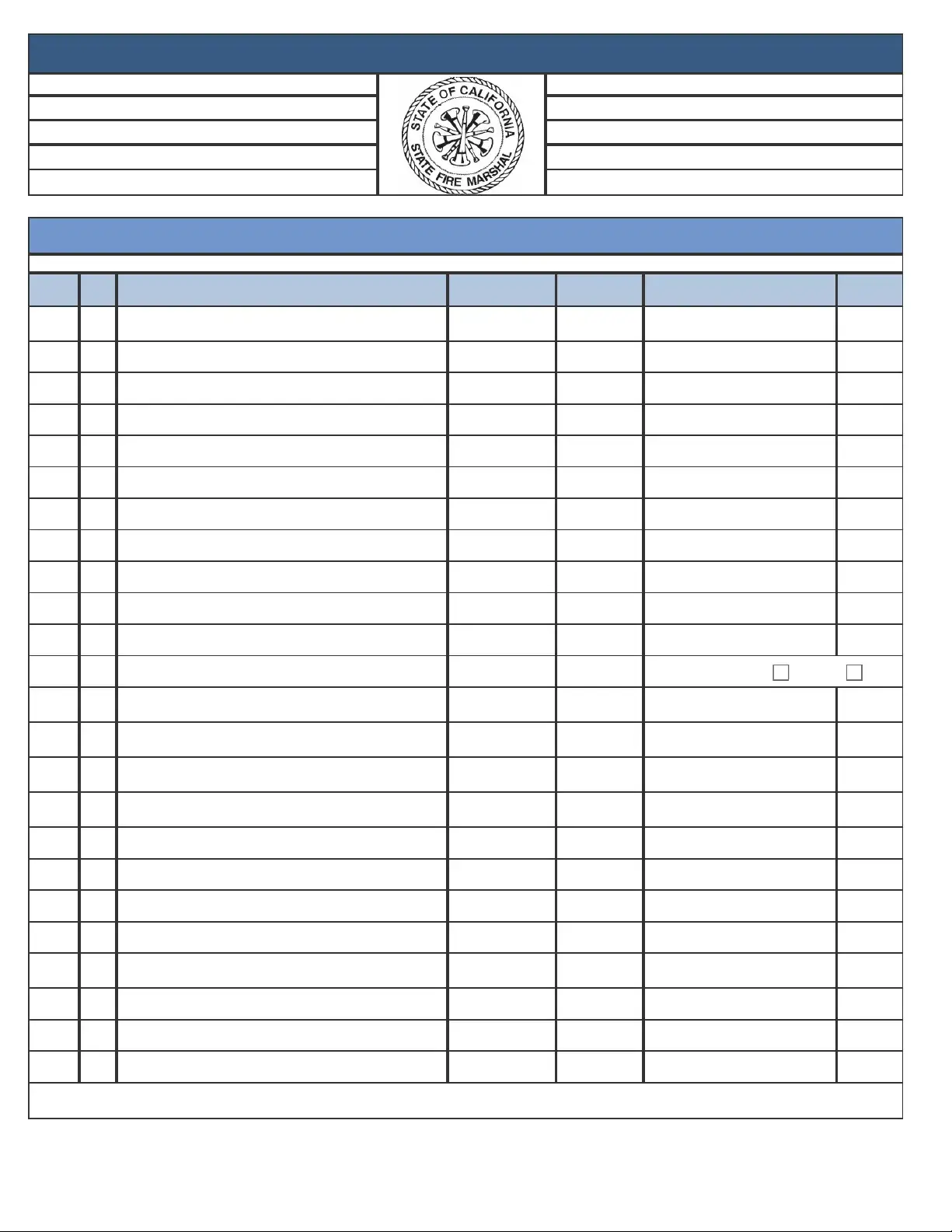
Preview - 5 Year Fire Sprinkler Inspection Form

Wet Pipe
Fire Sprinkler System
California Code of Regulations - Title 19
Inspection, Testing, and Maintenance
5-Year
Report
1 of 3
Property Information Contractor or Licensed Owner Information
Building Name
Name
Address
Address City St. Zip
City
License #
Phone
Contact Person
SFM Job #
CSLB Misc.
Riser Information Main Drain Test (ANNUAL)
Riser
No.
Location
Riser
Diameter
Main Drain
Diameter
Initial Static
Pressure
Residual
Pressure
Final Static
Pressure
P, F, N/A
This building has more than 5 risers. See additional AES 2.9 form attached Number of AES 2.9 forms attached:
5-Year INSPECTION, TESTING AND MAINTENANCE
Includes ALL Quarterly and Annual Inspections, Tests, and Maintenance items
I = Inspection T = Test M = Maintenance
P = Pass F = Fail N/A = Not Applicable
Item Description
NFPA 25 CA
ed.
Reference
Date Comments Only P, F, N/A
1.1 I Control Valves – Identification Sign 13.3.1
1.2 I Control Valves – Inspection 13.3.2
1.3 I Waterflow Alarm Devices 5.2.5
1.4 I Supervisory Devices 5.2.5
1.5 I Gauges (Wet Pipe Systems) 5.2.4.1
1.6 I
Hydraulic Design Information Sign
(For hydraulically designed systems)
5.2.6
1.7 I
Enter Water Supply Pressure Below Riser Check
5.2.4.1 psi
1.8 I
Enter Water Supply Pr
essure Above Riser Check 5.2.4.1 psi
1.9 I
Pressure Readings Acceptable
5.2.4.1
1.10 I
General Information Sign
(not required for system prior to 2007 Edition NFPA 13)
5.2.8
1.11 I Heat Tape 5.2.7
1.12 I Spare Sprinklers 5.2.1.4
1.13 I Fire Department Connections 13.7
1.14 I Alarm Valves – Exterior Inspection 13.4.1
1.15 I Pressure Reducing Valves 13.5.1.1
1.16 I Backflow Preventers 13.6.1
Form AES 2.
2
Se
p
t. 3, 2013
Wet Pipe
Fire Sprinkler System
California Code of Regulations - Title 19
Inspection, Testing, and Maintenance
5 Year
Report
2 of 3
Property Information Contractor or Licensed Owner Information
Building Name Name
Address Job #
City
ANNUAL INSPECTION, TESTING, AND MAINTENANCE
Include ALL Quarterly Inspections (See AES 2.1)
I = Inspection T = Test M = Maintenance
P = Pass F = Fail N/A = Not Applicabl
e
Item Description
NFPA 25 CA ed.
Reference
Date Comments Only P,F,N/A
1.17 I Small Hose Connections - Hose Valve*
5.1.6, 13.5.2
13.5.5.1
1.18 I PRV – Fire Sprinkler Systems 13.5.1.1
1.19 I Buildings (Freeze Protection) 4.1.1.1 Owner’s Responsibilit
y
1.20 I Sprinklers 5.2.1
1.21
I Sprinklers - Accessible Concealed Space 5.2.1.1.6
1.22
I Pipe and Fittings 5.2.2
1.23
I Pipe and Fittings - Accessible Concealed Space 5.2.2.3
1.24 I Hangers 5.2.3
1.25 I Hangers - Accessible Concealed Space 5.2.3.3
1.26 I Seismic Braces 5.2.3
1.27 I Seismic Braces - Accessible Concealed Space 5.2.3.3
1.28 I Unsprinklered Areas CFC 901.4 Yes No
2.1 T
Field Service Test Required
Send Report to Fire Code Official
5.3.1
If REQUIRED, Enter 'F' until
results are returned from Lab
2.2 T
Recalled Sprinklers
If not present = Pass; If present = Fail
Title 19
904.1(c)
2.3 T
Water Flow Alarm Devices
90 secs max. Enter time
5.3.3
13.2.6
sec.
2.4 T
Main Drain Test
(Enter data on Page 1 of this form)
13.2.5
13.3.3.4
2.5 T Control Valve - Position 13.3.3.2
2.6 T Control Valve – Operation 13.3.3.1
2.7 T Supervisory Devices 13.3.3.5
2.8 T Backflow Preventer Assemblies 13.6.2
2.9 T
Small Hose Connections*
w/PRV Hose Valves – Partial Flow Test
13.5.2.3
13.5.3.3
2.10 T PRV – Fire Sprinkler Systems 13.5.1.3
2.11 T Pressure Gauges - Calibration 5.3.2
2.12 T
Small Hose Connections
*
13.5.6.2.2
* Small hose connections are hose valves and optional hose supplied by the fire sprinkler system. They do not include Class I, II, or III
standpipe systems.
Form AES 2.
2
Se
p
t. 3, 2013
Wet Pipe
Fire Sprinkler System
California Code of Regulations - Title 19
Inspection, Testing, and Maintenance
Property Information Contractor or Licensed Owner Information
Building Name Name
Address Job #
City
ANNUAL INSPECTION, TESTING, AND MAINTENANCE
include ALL Quarterly Inspections (See AES 2.1)
I = Inspection T = Test M = Maintenance P = Pass F = Fail N/A = Not Applicable
Item Description
NFPA 25 CA ed.
Reference
Date Comments Only P,F,N/A
3.1 M Check Valves - Internal inspection 13.4.2
3.2 M Control Valves 13.3.4
3.3 M FDC - Backflush
14.3.2.3
14.3.2.4
3.4 M
Internal Pipe Inspection - See Deficiencies and
Comments Section for Results.
14.2
Yes
No
3.5 M
Obstruction Inv
estigation Required. If "Yes", see
Deficiencies and Comments Section for Results
14.3
3.6 M System Returned to Service 4.5.3
Yes
No
D = Deficiency C = Comment (Indicate type )
Item Date Riser D C
Deficiencies and Comments
Indicate all equipment, devices and parts that were repaired or replaced
Check here if additional Deficiencies and Comments are listed on Form AES 9
See Correction Form AES 10 for corrected deficiencies.
Number attached:
Number attached:
I hereby certify that the fire protection equipment listed above has been fully inspected, tested, and maintained on this date by
the company indicated above, in accordance with CCR, Title 19, Sections 901 to 906 and that the equipment is fully operable
except as noted in the “Deficiencies and Comments” section of this form.
Print Name
Signature Date
Form AES 2.
2
Se
p
t. 3, 2013
5
Year
Report
3 of 3

Document Specifics

Fact Name Description
Purpose The 5 Year Fire Sprinkler Inspection form is used to document the inspection, testing, and maintenance of fire sprinkler systems in compliance with state regulations.
Governing Law This form adheres to the California Code of Regulations, Title 19, which outlines the standards for fire safety and sprinkler system maintenance.
Inspection Frequency Inspections must occur every five years, with additional quarterly and annual inspections required to ensure ongoing compliance and safety.
Documentation Requirements All findings must be documented on the form, including any deficiencies or maintenance performed, to ensure a complete record of the system's status.

5 Year Fire Sprinkler Inspection: Usage Instruction

Completing the 5 Year Fire Sprinkler Inspection form is a crucial task that ensures the safety and compliance of your fire protection system. This process requires careful attention to detail and accurate information to meet regulatory standards. Follow the steps below to fill out the form correctly.

  1. Start with the Property Information. Fill in the building name, address, city, state, and zip code.
  2. Provide the Contractor or Licensed Owner Information. Enter the name, address, city, license number, phone number, and contact person.
  3. Complete the Riser Information section. Indicate the riser location and fill in the main drain test details, including initial static pressure, residual pressure, and final static pressure.
  4. If applicable, note the number of additional AES 2.9 forms attached if the building has more than five risers.
  5. In the 5-Year Inspection, Testing, and Maintenance section, mark the appropriate boxes for each item listed (I, T, M) based on the inspection results. Use P for Pass, F for Fail, and N/A for Not Applicable.
  6. For each item, provide the Date of inspection and any Comments as necessary.
  7. Continue with the Annual Inspection, Testing, and Maintenance section. Repeat the process of marking the appropriate boxes and providing dates and comments for each item listed.
  8. In the Deficiencies and Comments section, indicate any deficiencies or comments related to the equipment inspected. Mark if additional comments are listed on Form AES 9.
  9. Finally, certify the inspection by printing your name, signing the form, and entering the date.

Once you have completed the form, ensure that all sections are filled out accurately. This document should then be submitted to the relevant fire code official or regulatory body as required. Proper submission helps maintain compliance and enhances safety measures within the property.

Learn More on 5 Year Fire Sprinkler Inspection

What is the purpose of the 5 Year Fire Sprinkler Inspection form?

The 5 Year Fire Sprinkler Inspection form is designed to ensure that fire sprinkler systems are regularly inspected, tested, and maintained. This helps to guarantee that the systems function properly in case of a fire, protecting lives and property.

Who is responsible for completing the form?

The form should be completed by a licensed contractor or a qualified individual responsible for the fire sprinkler system. This person must have the necessary training and credentials to ensure that all inspections and tests are conducted correctly.

What information is required on the form?

Key information includes:

  • Building name and address
  • Contractor or licensed owner's name and contact details
  • Job number
  • Details of the inspection, testing, and maintenance performed

This information helps track the history and status of the fire sprinkler system.

What types of inspections are included?

The form covers various inspections, tests, and maintenance activities. These include:

  1. Control valve inspections
  2. Water flow alarm device tests
  3. Sprinkler assessments
  4. Pipe and fitting checks

These inspections ensure that every part of the system is functioning as it should.

What does the "P, F, N/A" notation mean?

This notation stands for Pass, Fail, and Not Applicable. After each inspection item, the inspector will mark whether the item passed the inspection, failed, or was not applicable to that specific system. This helps in identifying areas that need attention.

How often should the form be completed?

The form must be completed every five years. However, it also includes annual inspections and quarterly checks to ensure the system remains in good working order throughout the year.

What happens if deficiencies are found?

If deficiencies are identified during the inspection, they must be documented in the "Deficiencies and Comments" section of the form. The contractor should address these issues promptly to ensure the fire sprinkler system remains operational.

Where should the completed form be sent?

After completing the form, it should be sent to the local fire code official. This keeps the authorities informed about the condition of the fire sprinkler system and ensures compliance with safety regulations.

Common mistakes

Completing the 5 Year Fire Sprinkler Inspection form accurately is essential for compliance and safety. However, many individuals make common mistakes that can lead to significant issues. Understanding these errors can help ensure a smoother process.

One frequent mistake is neglecting to fill out the Property Information section completely. This includes details such as the building name, address, and job number. Incomplete information can delay processing and create confusion about the inspection's location.

Another common error involves the Contractor or Licensed Owner Information. Failing to include the contractor's license number or contact details may hinder communication. Proper identification of the responsible party is crucial for accountability.

Individuals often overlook the Main Drain Test section. This part requires specific pressure readings. If these values are not recorded or are inaccurate, it may suggest that the system is not functioning correctly, potentially leading to safety hazards.

People sometimes misinterpret the Inspection, Testing, and Maintenance codes. Each item listed on the form corresponds to specific standards. Not marking an item as “Pass” or “Fail” can lead to misunderstandings about the system’s condition.

Another mistake is not providing adequate Comments for each inspection item. Comments are essential for clarity, especially when issues arise. A lack of detail can leave inspectors and future technicians without necessary context.

Some individuals mistakenly believe that all items are applicable to their system. The N/A option should be used for items that do not apply. Failing to mark these can lead to confusion and misinterpretation of the inspection results.

Inaccurate dates are another common issue. Each inspection item should have the correct date of testing or maintenance. If dates are missing or incorrect, it may raise questions about the validity of the inspection.

People often forget to sign and date the form. This final step is crucial as it certifies that the inspection was conducted and that the information provided is accurate. Without a signature, the form may be considered incomplete.

Lastly, individuals may not attach necessary additional forms, such as the AES 2.9 for buildings with more than five risers. Failing to include these forms can result in non-compliance and additional follow-up actions.

By being aware of these common mistakes, individuals can take proactive steps to ensure the 5 Year Fire Sprinkler Inspection form is completed accurately. This diligence not only aids in compliance but also enhances the safety of the fire sprinkler system.

Documents used along the form

When conducting fire sprinkler inspections, several additional forms and documents may be required to ensure compliance and thorough record-keeping. These documents help in maintaining safety standards and tracking the performance of fire protection systems over time. Below is a list of relevant forms that are commonly used alongside the 5-Year Fire Sprinkler Inspection form.

  • AES 2.1 Quarterly Inspection Form: This form is used to document the quarterly inspections of fire sprinkler systems. It includes a checklist of items to be inspected, ensuring that all components are functioning properly between annual inspections.
  • AES 2.9 Additional Riser Information Form: If a building has more than five risers, this form is necessary to provide detailed information about each riser. It captures data such as location and performance metrics, which are crucial for comprehensive system evaluations.
  • AES 9 Deficiencies and Comments Form: This document is used to report any deficiencies found during inspections. It allows inspectors to note any repairs needed and to track the status of those repairs, ensuring that all issues are addressed promptly.
  • AES 10 Correction Form: Following the identification of deficiencies, this form is utilized to document corrections made. It serves as a record of actions taken to resolve issues and helps maintain compliance with safety regulations.
  • Annual Fire Safety Report: This report summarizes the overall condition and performance of the fire protection systems in a building. It includes findings from all inspections conducted throughout the year and provides recommendations for improvements or necessary upgrades.

Using these forms in conjunction with the 5-Year Fire Sprinkler Inspection form creates a comprehensive framework for ensuring fire safety. It is crucial to maintain accurate and up-to-date records, as they not only help in compliance but also enhance the safety of building occupants.

Similar forms

The Fire Alarm System Inspection Report serves a similar purpose to the 5 Year Fire Sprinkler Inspection form by documenting the inspection, testing, and maintenance of fire alarm systems. This report typically includes details about the various components of the fire alarm system, such as detectors, alarms, and control panels. Like the sprinkler inspection form, it outlines whether each component passed or failed the inspection, along with any necessary maintenance actions. Both documents aim to ensure compliance with safety regulations and to maintain the operational readiness of fire safety systems.

The Annual Fire Safety Inspection Report is another document that aligns closely with the 5 Year Fire Sprinkler Inspection form. This report focuses on a comprehensive evaluation of a building's fire safety measures, which may include fire extinguishers, exit routes, and emergency lighting, in addition to fire sprinkler systems. Similar to the sprinkler inspection, it requires the documentation of inspections, tests, and maintenance actions taken throughout the year. The goal is to ensure that all fire safety equipment is functioning properly and meets local fire codes.

The Emergency Exit Sign Inspection form shares similarities with the 5 Year Fire Sprinkler Inspection form in that it provides a systematic approach to ensuring safety equipment is operational. This form focuses specifically on emergency exit signs and lighting, documenting their condition and any required maintenance. Both forms emphasize the importance of regular inspections and compliance with safety standards, contributing to overall building safety during emergencies.

Lastly, the Fire Extinguisher Inspection Report is akin to the 5 Year Fire Sprinkler Inspection form as it records the inspection and maintenance of portable fire extinguishers. This report includes details such as the location, type, and condition of each extinguisher, along with the results of any tests performed. Like the sprinkler inspection form, it serves to verify that fire safety equipment is ready for use in case of an emergency, ensuring compliance with applicable regulations and standards.

Dos and Don'ts

When filling out the 5 Year Fire Sprinkler Inspection form, it is essential to adhere to best practices to ensure accuracy and compliance. Below is a list of dos and don’ts to consider:

  • Do provide complete and accurate property information, including the building name, address, and contractor details.
  • Do use the correct codes and references as specified in the form, ensuring that all NFPA standards are met.
  • Do clearly indicate the status of each inspection item (Pass, Fail, Not Applicable) in the designated columns.
  • Do include comments for any items marked as Fail or with deficiencies to provide context and clarity.
  • Don't leave any sections blank; ensure every part of the form is filled out to avoid delays in processing.
  • Don't use abbreviations or shorthand that may not be understood by all parties reviewing the form.
  • Don't forget to sign and date the form, as this certifies the inspection has been conducted in accordance with the regulations.

Misconceptions

Misconception 1: The 5 Year Fire Sprinkler Inspection form is only for new installations.

This form applies to all fire sprinkler systems, regardless of when they were installed. Existing systems must also undergo regular inspections, testing, and maintenance.

Misconception 2: Completing the form is optional.

Misconception 3: Only licensed contractors can fill out the form.

Misconception 4: The form only needs to be submitted once every five years.

Misconception 5: The form is the same for all types of fire sprinkler systems.

Misconception 6: If there are no deficiencies noted, the inspection is not necessary.

Key takeaways

Filling out the 5-Year Fire Sprinkler Inspection form is essential for maintaining safety and compliance. Here are some key takeaways to keep in mind:

  • Accurate Information: Ensure that all property and contractor information is filled out correctly. This includes the building name, address, and contact details.
  • Inspection Details: The form includes sections for various inspections, tests, and maintenance tasks. Familiarize yourself with these items to ensure nothing is overlooked.
  • Use of Codes: Reference the relevant NFPA codes and California regulations when completing the form. This ensures compliance with legal standards.
  • Record Keeping: Keep a copy of the completed form for your records. This is important for future inspections and audits.
  • Timely Submission: Submit the completed form to the appropriate fire code official promptly. Delays can lead to compliance issues.
  • Check for Deficiencies: Pay close attention to the deficiencies and comments section. Document any repairs or replacements needed for transparency.
  • Annual Tests: Remember that the form includes annual testing requirements. Schedule these tests in advance to avoid lapses in compliance.
  • Certification: Ensure that the form is signed and dated by the responsible party. This certification confirms that all inspections and tests were completed as required.