Go Law
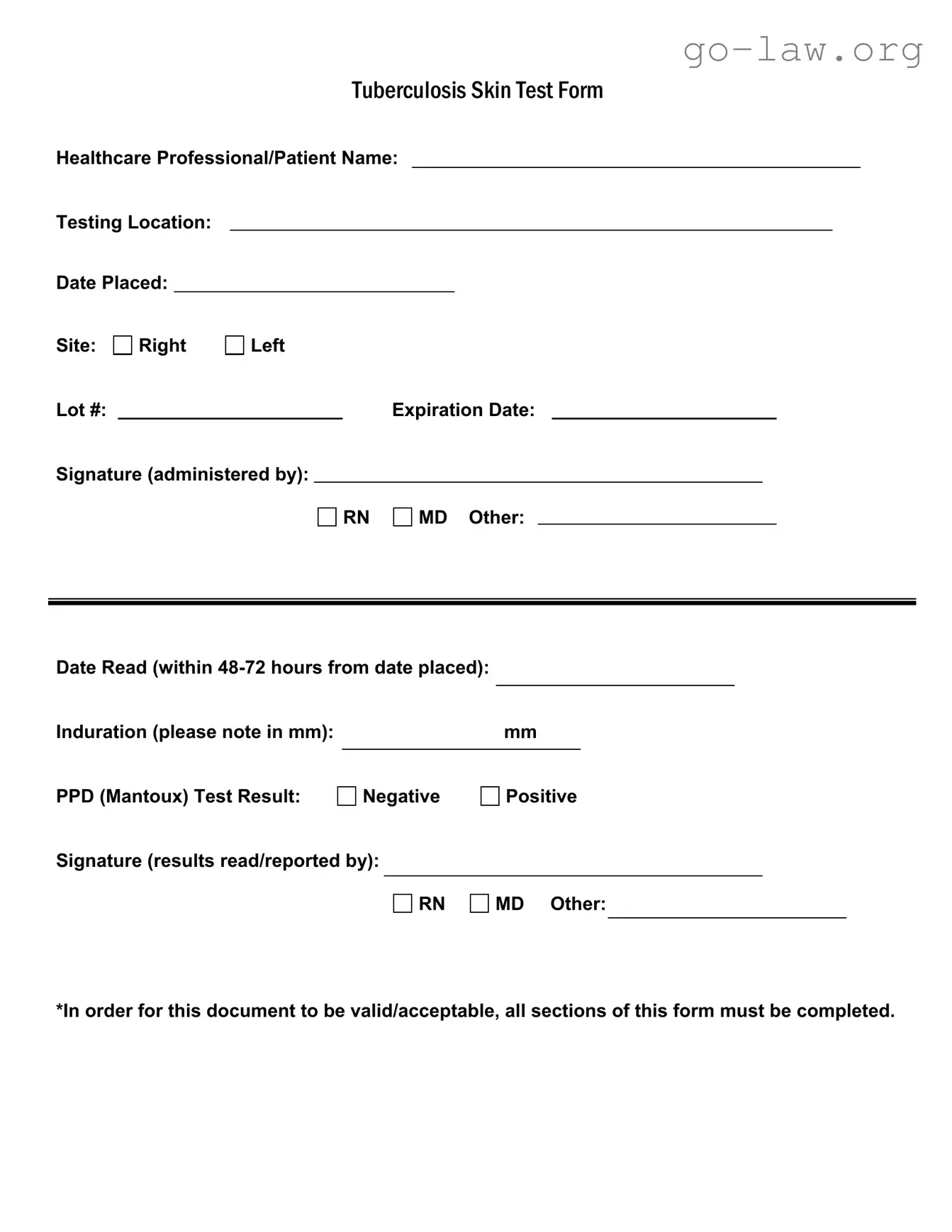
The Tuberculosis (TB) Skin Test Form is a crucial document used in healthcare settings to record essential information regarding TB testing. It includes the names of both the healthcare professional and the patient, ensuring clear identification of those involved in the testing process. The form specifies the testing location and the date the test was placed, which are vital for tracking and follow-up purposes. Additionally, it requires the site of the test to be indicated, allowing for precise documentation. A lot number and expiration date are also necessary, as they confirm the validity of the testing materials used. The signature of the administering professional—whether a registered nurse (RN), medical doctor (MD), or other qualified personnel—is required to authenticate the procedure. After the test is read, typically within 48 to 72 hours, the induration measurement in millimeters must be recorded, followed by the result of the PPD (Mantoux) test, which can be either negative or positive. The form concludes with a signature from the individual who read and reported the results, further ensuring accountability. For the document to be valid and acceptable, it is imperative that all sections are completed thoroughly.

|
|
|
|
|
TUBERCULOSISSKINTESTFORM |
||||||||
Healthcare Professional/Patient Name: |
|||||||||||||
Testing Location: |
|
|
|
|
|
|
|
|
|
|
|
||
Date Placed: |
|
|
|
|
|
|
|
|
|
|
|
|
|
Site: |
Right |
Left |
|
|
|
|
|
|
|
|
|||
Lot #: |
|
|
|
|
|
Expiration Date: |
|
|
|||||
Signature (administered by): |
|
|
|
|
|
|
|
|
|
||||
|
|
|
|
|
RN |
|
MD Other: |
|
|
|
|||
Date Read (within |
|
|
|
|
|
|
|
Induration (please note in mm): |
|
mm |
|
PPD (Mantoux) Test Result: |
|
|
|
Negative |
Positive |
||
Signature (results read/reported by):
RN
MD Other:
*In order for this document to be valid/acceptable, all sections of this form must be completed.
| Fact Name | Details |
|---|---|
| Form Title | Tuberculosis Skin Test Form |
| Healthcare Professional | Form requires the name of the healthcare professional administering the test. |
| Testing Location | The location where the test is administered must be clearly indicated. |
| Date Requirements | The test must be read within 48-72 hours from the date it was placed. |
| Test Result | Results can be either Negative or Positive, noted on the form. |
| State-Specific Laws | Check local regulations; requirements may vary by state (e.g., California Health and Safety Code § 121365). |
Filling out the TB Test form is an important step in ensuring that all necessary information is captured accurately. Once completed, this form will help healthcare professionals assess the results of the test and maintain proper records. Follow these steps carefully to fill out the form correctly.
Make sure all sections of the form are filled out completely. This ensures the document is valid and acceptable for medical records and further action if necessary.
The TB Test form is used to document the administration and results of a tuberculosis skin test, commonly known as the PPD (Purified Protein Derivative) test. This test helps determine if an individual has been exposed to the bacteria that cause tuberculosis. Completing the form accurately is essential for tracking and managing TB testing, especially in healthcare settings or for individuals who may be at higher risk.
To ensure the form is valid and acceptable, all sections must be completed. Here’s a list of the essential information needed:
The results of the TB test must be read within 48 to 72 hours after the test is placed. This timeframe is crucial because it allows for the accurate measurement of induration, which is the raised area at the injection site. If the results are not read within this window, the test may need to be repeated to ensure accurate results.
The results of the TB test can be either negative or positive. A negative result typically means that there is no current infection with the tuberculosis bacteria. Conversely, a positive result indicates that the individual has been exposed to the bacteria at some point. However, it does not necessarily mean the person has active tuberculosis disease. Further evaluation and testing may be required to determine the next steps.
Filling out the Tuberculosis (TB) Skin Test form may seem straightforward, but many individuals make common mistakes that can lead to complications. One of the most frequent errors is failing to complete all sections of the form. Each part, from the healthcare professional's name to the result of the test, is crucial. Omitting even one detail can render the document invalid. It’s essential to double-check that every section is filled out before submission.
Another mistake often encountered is incorrect date placement. The form requires specific dates, such as when the test was placed and when it was read. If the dates do not align with the testing protocol, it can create confusion and may delay necessary follow-up actions. Make sure to keep track of these dates carefully, as they are vital for accurate record-keeping.
People also frequently misreport the induration measurement. The induration is the raised area at the test site and must be measured in millimeters. Misreading this measurement can lead to incorrect conclusions about the test results. Always use a ruler or measuring tape to ensure accuracy, as this detail is critical for determining whether the result is negative or positive.
Finally, many individuals overlook the requirement for signatures on the form. Both the person administering the test and the one reading the results must sign the document. Without these signatures, the form lacks authenticity and could be deemed unacceptable. Be diligent about ensuring that all necessary signatures are present to validate the test results.
The Tuberculosis (TB) Test form is an essential document used to record the administration and results of a TB skin test. Several other forms and documents are often used in conjunction with the TB Test form to ensure comprehensive health records and facilitate proper medical care. Below is a list of these documents, each serving a specific purpose.
Each of these documents plays a crucial role in the overall process of TB testing and management. They help maintain accurate health records, ensure patient safety, and facilitate effective communication among healthcare providers. Proper documentation is vital in providing quality care and support for patients undergoing TB testing and treatment.
The TB Test form shares similarities with the Immunization Record. Both documents serve to track important health information regarding an individual’s immunization status. The Immunization Record includes details such as the type of vaccine administered, the date it was given, and the healthcare professional's signature. Like the TB Test form, it requires complete information to be valid, ensuring that individuals have a comprehensive record of their vaccinations for school, work, or travel purposes.
Another document similar to the TB Test form is the Medical History Questionnaire. This form gathers essential information about a patient's past medical conditions, medications, and allergies. Both documents are crucial for healthcare providers to assess a patient’s health status accurately. They require detailed responses to specific questions, allowing healthcare professionals to make informed decisions about care and treatment.
The Health Screening Form also resembles the TB Test form in its purpose of gathering health-related information. Health screenings often include questions about symptoms, lifestyle choices, and potential exposure to diseases. Like the TB Test form, it is designed to be filled out by the patient, ensuring that healthcare providers have the necessary information to evaluate health risks and recommend appropriate follow-up actions.
Finally, the Consent Form for Medical Procedures is another document that parallels the TB Test form. Both forms require signatures from healthcare professionals and patients, indicating that the necessary information has been reviewed and understood. The Consent Form outlines the risks and benefits of a procedure, while the TB Test form documents the administration and results of the test. Each form plays a vital role in ensuring informed consent and proper medical record-keeping.
When filling out the TB Test form, attention to detail is crucial. Here are six important dos and don'ts to keep in mind:
Completing the form accurately is essential for valid results. Take the time to review your entries before submission.
There are several misconceptions about the Tuberculosis (TB) Test form that can lead to confusion. Here are four common ones:
Filling out the TB Test form correctly is crucial for accurate results and compliance with health regulations. Here are some key takeaways to keep in mind:
By following these guidelines, you can ensure that the TB Test form is filled out correctly and serves its purpose effectively.